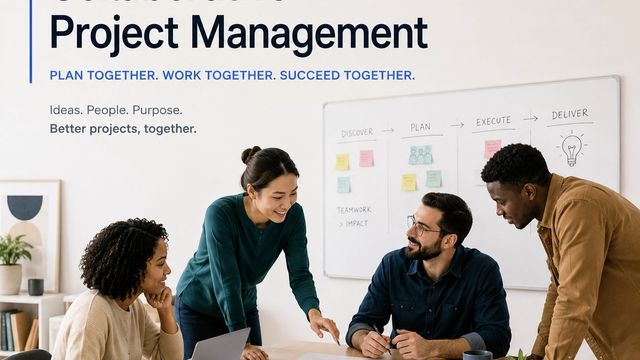
Why Traditional Project Management Is Struggling to Keep Up
For decades, traditional project management was the standard way to deliver work. Teams created detailed plans, defined every requirement upfront, and followed a structured path from start to finish. In stable industries, this approach worked well.
Today, however, the business environment looks very different.
Technology evolves quickly. Customer expectations change constantly. New competitors can disrupt entire markets almost overnight. In this kind of environment, project plans that seemed solid six months ago can become outdated before the project is finished.
As a result, many organizations are discovering that the methods they once relied on are now slowing them down.
The Limits of the Waterfall Approach
Traditional project management is often associated with the waterfall model, a process that moves through a series of stages in sequence: planning, design, execution, testing, and delivery.
The strength of this approach is clarity. Everyone understands the plan, responsibilities are defined early, and progress can be measured against predetermined milestones.

The problem is that waterfall assumes the future is predictable.
"When change is constant, a rigid project plan becomes less of a roadmap and more of a roadblock."
When requirements change midway through a project, adjustments can become expensive and time-consuming. Teams may need to revise documentation, secure new approvals, or revisit work that was previously considered complete. In fast-moving industries, this rigidity can create delays and frustration.
Consider a software project that takes a year to complete. Customer needs, market conditions, or technology standards may shift several times during that period. By the time the product launches, it may no longer solve the problem it was originally designed to address.
Why Agile Gained Momentum
Agile emerged largely as a response to these challenges.

Instead of treating a project as a single long journey, Agile breaks work into smaller cycles. Teams build, test, gather feedback, and make improvements continuously. This allows them to respond to change without disrupting the entire project.
The emphasis shifts from following a fixed plan to delivering value consistently.
Regular collaboration is another key difference. Agile teams communicate frequently, involve stakeholders throughout the process, and adjust priorities based on new information. Rather than waiting until the end of a project to discover problems, they identify and address issues as they arise.
This approach is particularly valuable in industries where customer expectations and technology evolve rapidly.
The Real Challenge: Changing Mindsets
While Agile and other modern frameworks offer clear advantages, adopting them is rarely straightforward.

The biggest obstacle is often not the process itself but the people involved.
Many organizations have spent years building systems around traditional project management. Leaders are accustomed to detailed plans and predictable timelines. Team members may feel more comfortable with clearly defined procedures and responsibilities.
"In today's business landscape, adaptability is no longer a competitive advantage. It's a survival skill."
Moving to a more flexible approach requires a different mindset. Teams must become comfortable with uncertainty, experimentation, and continuous adjustment. Leaders must focus less on controlling every step and more on enabling collaboration and problem-solving.
Without cultural change, even the best methodology can fail.
Technology Is Part of the Solution
Modern project management also depends heavily on technology.
Collaboration platforms, task management tools, and real-time reporting systems allow teams to work more transparently and make faster decisions. These tools provide visibility into project status while making it easier to adapt when priorities change.
Technology alone is not enough, but it can support the flexibility that modern projects require.
What Successful Organizations Are Doing Differently
Organizations that manage change effectively tend to share a few common characteristics:
- They encourage continuous learning.
- They prioritize collaboration over rigid hierarchy.
- They involve customers and stakeholders throughout the project lifecycle.
- They use data to guide decisions rather than relying solely on initial assumptions.
- They view change as an opportunity rather than a disruption.
Above all, they recognize that no single methodology works for every situation. Instead of choosing between traditional and Agile approaches, many successful teams combine elements of both, creating a framework that fits their specific needs.
Looking Ahead
Traditional project management is not obsolete. Its strengths, including structure, accountability, and documentation, remain valuable in many environments.
The challenge is knowing when those strengths become limitations.
As projects become more complex and business conditions change faster than ever, organizations need approaches that balance planning with adaptability. The teams that succeed will be those that can maintain direction while remaining flexible enough to respond when circumstances change.
Project management is no longer just about delivering projects on time and within budget. It is about creating the ability to adapt, learn, and deliver value in an environment where change is the only constant.
#ProfessionalDevelopment #AgileMethodology #ProjectManagement #ChangeManagement #TeamCollaboration
Disclaimer: The views expressed in this article are personal in nature, for informational purposes only, and do not constitute professional, operational, or financial advice for specific manufacturing facilities.
Further reading
- Agile Project Management vs. Traditional Approaches: A Comparative Study of Benefits, Challenges, and Recommendations
International Journal of Engineering Research & Technology
This comparative study outlines the challenges of traditional project management, particularly its rigidity and limited stakeholder engagement.
- Traditional vs Agile: Differences, Similarities, Pros & Cons
ONETHREAD
This article discusses the limitations of traditional project management methods and contrasts them with the more adaptable Agile approach.
- Traditional Project Management: Everything You Need to Know
TIZAVO
This resource highlights the constraints of traditional project management methodologies, particularly their inflexibility and potential for delays.
- Waterfall Project Management: Methodology, Phases, Benefits, And Limitations
BAKKAH
This article outlines the limitations of the Waterfall methodology, a traditional project management approach, emphasizing its inefficiency in adapting to changes.