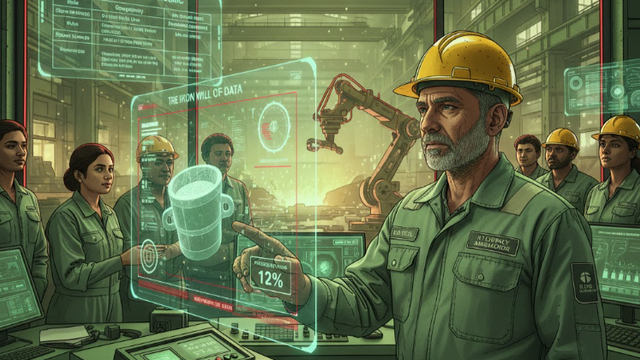
The Engine and the Autopilot
Implementing AI in heavy manufacturing without a strong operational and digital foundation is like installing a self-driving system on a car that doesn’t yet have a reliable engine. It looks futuristic in presentations, but it won’t move in reality. Across steel, automotive, and cement, a recurring pattern has emerged: organizations invest in AI with high expectations, yet most initiatives quietly fade away after the pilot phase.
This isn't a technology problem – It is a maturity problem.
Part 1: The Illusion of the Tech Upgrade
Many leaders approach AI as they would a new physical machine installation: define scope, select a vendor, and run a pilot. But AI is not a machine. It does not deliver value simply because it is installed.
AI only delivers value when it changes how daily decisions are made on the shop floor. If your decision-making processes remain static, AI becomes just another reporting tool rather than a performance tool.
Why Initiatives Collapse
When AI fails, it is rarely for one reason. It is usually a perfect storm of:
- Poor or unreliable data.
- Leadership hype without a clear road map.
- Workforce resistance (the silent killer).
- No redesign of decision workflows.
Part 2: The Data & Sensor Reality Check
In a steel mill or cement plant, the environment is hostile. Sensors must survive extreme heat, dust, vibration, and mechanical shocks. Calibration drifts and messy data historians are the norm, not the exception.
However, modern AI can partially compensate for these dirty environments through:
- Soft Sensors: Virtual estimation models that predict values when physical sensors fail.
- Sensor Fusion: Combining multiple data points to verify accuracy.
- Anomaly Detection: Identifying faulty readings before they corrupt the model.
- The Uncomfortable Truth: Even plants with good data often fail. Data problems are visible and fixable with money; deeper organizational issues are not.
Part 3: The Biggest Killer—Leadership Hype
Most initiatives derail when leadership issues a vague directive to implement AI across the plant without defining a specific business problem or measurable impact.
- Year 1: The pilot is launched, dashboards are created, and presentations look impressive.
- Year 2: There is no integration into daily operations; operators stick to traditional methods, and the system is gradually ignored.
Ultimately, a plant only respects metrics like throughput, yield, energy cost, and downtime. If AI can’t move these needles, it won’t survive the pilot phase.
Part 4: Overcoming the Silent No (Workforce Resistance)
Frontline teams often perceive AI as a threat to their judgment or an extra documentation burden. This resistance is rarely vocal—it is passive. It looks like it ignored alerts and bypassed workflows.
The Winning Model: Augment humans, don't replace them. The goal is Human Judgment + AI Recommendation
Part 5: The Missing Link—Decision Workflow Redesign
This is the most critical and ignored factor. If a predictive maintenance system identifies a bearing failure in 20 days, what happens next?
- Who validates the alert?
- Who schedules the intervention?
- How is production planning adjusted?
If these workflows aren't redesigned, the AI insight is just another notification. AI must be embedded into the morning production meetings and quality reviews.
Part 6: Capturing Tribal Knowledge
As experienced professionals retire, their intuition—like sensing a furnace imbalance by sound—walks out the door.
AI and Digital Twins offer a way to institutionalize decades of operational intuition into data-driven systems.
The Maturity Path Forward
Where does your plant actually stand? Most are stuck at Level 2, even if they have fancy monitors.

To succeed, plants must move from Level 1 (Discussion) to Level 5 (Optimization Culture).
- Start with one painful business problem, not an AI transformation.
- Make operations the owner—if IT owns AI, it’s a reporting tool; if operations owns it, it’s a decision tool.
- Integrate into daily routines.
Final Thought
The future gap won’t be between plants with AI and those without. It will be between plants that changed how decisions are made and those that did not.
AI does not fail in factories—transformation discipline does.
[The thoughts and opinions expressed in this article are personal]