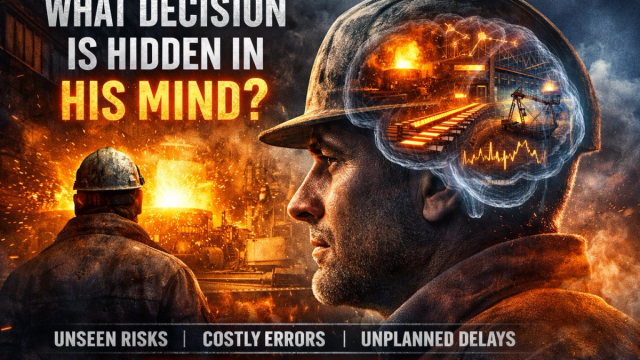
Manufacturing—and steel in particular—is entering an era where volatility, complexity, and scale have officially overwhelmed traditional planning, scheduling, and control paradigms. For decades, the industry has chased the "Perfect Plan," a static masterpiece of logistics that looks beautiful on a Monday morning but is in shambles by Tuesday noon.
The core thesis for the next decade of industrial leadership is simple: competitive advantage will shift from planning accuracy to decision quality under uncertainty. To survive, plants must stop trying to predict the future and start building systems that can handle any future that arrives.
1. The Anatomy of Decision Failure
Why do our current systems break? Traditional decisions fail because they are designed for a "steady state" that no longer exists.
Decisions That Only Work at Low Volumes
Many plants still rely on human cognition, informal coordination, or static "rules of thumb". While an experienced scheduler can manage a simple product mix, these methods collapse as combinatorial complexity increases.
- Experience-based scheduling becomes a bottleneck when thousands of variables are involved.
- Rule-of-thumb inventory buffers are either too large (wasting capital) or too small (causing stock-outs).
- Case-by-case quality disposition leads to inconsistent customer outcomes and lost yield.
The Fragility of the "Frozen" Plan
Disruptions expose decisions that are brittle and assumption-heavy. When a plant relies on frozen master production plans or push-based production, any deviation causes cascading instability and "firefighting". Siloed functional optimization—where the melt shop optimizes for chemistry while the rolling mill optimizes for width—creates friction that erodes trust in the plan.
2. The Disruption-Native Paradigm: A New Operating Model
A disruption-native plant is not designed to eliminate disruptions, but to absorb, adapt, and learn from them continuously. This requires a fundamental shift in mindset: instability is normal, plans are merely hypotheses, and decisions must be continuously recomposed.
Foundational Principles
To move away from episodic re-planning, the plant must adopt a new set of principles:
- Continuous Sensing: Using probabilistic forecasting instead of static targets.
- System-Level Optimization: Prioritizing the flow of the entire plant over local machine efficiency.
- Risk Governance: Explicitly treating uncertainty and risk as variables in the decision-making process.
3. The "Decision Fabric": Unifying Planning, Scheduling, and Execution
The traditional separation between Planning and Scheduling Systems and Execution Systems has become a liability. In a high-volatility environment, the time it takes to "upload" a shop-floor delay to a planner and "download" a new schedule is too long.
The Evolution Stages
- Static/Reactive: Traditional systems where APS plans, and MES reacts.
- Event-Aware: Systems that attempt frequent re-planning based on shop-floor events.
- The Decision Fabric: A unified, decision-centric architecture where APS stops being a planner, and MES stops being an executor. Together, they form a continuous decision engine.
Capabilities of the Future Fabric
This unified engine provides probabilistic, yield-aware scheduling and real-time constraint inference. It utilizes micro-simulations at the moment of decision to ensure that every adjustment is synchronized with shop-floor reality and unified objective functions.
4. Deep Dive: The Hot Rolling Mill (HRM) Use Case
The Hot Rolling Mill is the heart of flat product production, where thermal constraints, metallurgical requirements, and customer deadlines collide. In a Disruption-Native plant, the "Decision Fabric" transforms the HRM workflow.
A. Slab Allocation: From Matching to Portfolio Optimization
Quality disposition evolves from simple pass/fail gates into portfolio optimization problems.
- Multi-Dimensional Variables: Decisions consider downstream demand flexibility, customer tolerance, logistics, and future demand scenarios.
- Yield-Aware Allocation: Instead of rejecting a slab with a minor chemistry deviation, the system calculates if the HRM can still meet the order's mechanical properties through specific rolling temperature profiles.
B. Scheduling: The Confidence-Weighted Hypothesis
There are no "frozen" rolling sequences here.
- Real-time Synchronization: The system constantly scans for reheat furnace efficiency or roll wear issues.
- Dynamic Recomposition: If a furnace underperforms, the "Decision Fabric" recomposes the sequence in real-time to maintain mill pace, rather than waiting for a manual intervention.
C. Execution: Autonomous Micro-Adjustments
In a disruption event—such as a critical upstream delay threatening rolling commitments—the system responds in layers.
- Immediate Shock Absorption: The execution layer makes autonomous micro-adjustments without human intervention.
- Context-Dependent Buffers: Dynamic buffers are actively rebalanced during the disruption to protect the flow.
5. The "Blind Spots": Questions Legacy Systems Can't Answer
If you are still operating with a traditional APS-MES setup, your C-suite is likely flying blind during a crisis. Current systems struggle to answer these critical questions:
- The Yield Integrity Question: "Given this specific slab defect, what is the statistical probability it will survive the cold-rolling process if we roll it now?"
- The Thermal Sync Question: "If we slow the mill by 10% to accommodate furnace lag, how does that ripple effect impact our energy surcharge costs across the next 48 hours?"
- The Opportunity Cost Question: "We have an emergency order from a Tier-1 automotive client. What is the exact dollar value of the 'churn' we create by breaking our current sequence?"
6. Autonomy Design: Risk over Trust
A common barrier to AI adoption is the fear of "black box" decisions. However, autonomy in a steel plant is about reversibility and blast radius, not just blind trust.
The Decision Hierarchy
Decision authority is structured by risk and impact, not organizational rank.
- Fully Autonomous: Local, reversible decisions like dispatching and routing.
- Guarded Autonomy: System-wide but recoverable decisions like sequencing and allocation.
- Human-in-the-Loop: Partially irreversible decisions like order matching or campaign shifts.
- Human-Only: Strategic trade-offs involving safety, customer commitments, and long-term intent.
Rule of Thumb: Automate what can be undone cheaply. Govern what affects long-term value or trust.
7. The Anti-fragile Outcome
The ultimate goal of a disruption-native plant is to become anti-fragile—a system that strengthens through exposure to variability. Every disruption feeds a learning loop that updates models, smarter buffers, and improved decision policies.
In a major disruption scenario, the plant flows around the disruption rather than reacting to it. Humans are no longer consumed by firefighting; instead, they are notified of high-level economic impacts and service-level risks, allowing them to approve objective shifts rather than tweaking detailed schedules.
8. Strategic Conclusion: A New Operating Model
While steel exposes these challenges early due to its capital intensity and tight process coupling, this paradigm applies to all complex manufacturing. Disruption-native, AI-driven decision systems are not just an optimization upgrade—they are a new operating model for the era of uncertainty.
Success in 2026 and beyond will be defined by those who stop fighting the volatility and start building the "Decision Fabric" to orchestrate it.