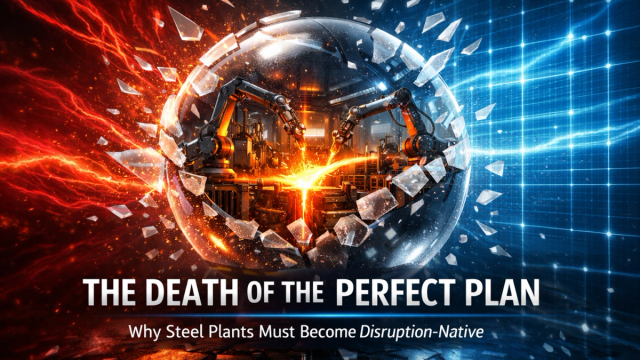
In the world of steel manufacturing, we often talk about the digital revolution as if it’s a magic wand. We imagine a future with Perfect AI: a system that has zero lag, no bias, and can predict exactly what will happen on the factory floor before it happens.
But there is a massive, expensive problem that no algorithm can solve: Accountability.
Even if the computer is 100% right, humans still have to decide who owns the consequences when a choice helps the whole company but makes one specific department look bad.
Why Steel is Different: The Point of No Return
Unlike a digital photo you can edit or an email you can recall, steel is a world of irreversible commitments. Once you take a step, you are locked in:
The Chemistry: Once you melt the raw iron and mix in the alloys (the heat), the chemical recipe is set in stone.
The Shape: Once a massive slab of red-hot steel is rolled into a thin sheet, you cannot unroll it back to its original thickness.
The Delivery: Once a 20-ton coil of steel is loaded onto a truck or ship, the logistics costs are committed.
The Promise: Once you tell a customer their steel will arrive on Tuesday, your reputation is on the line.
AI can tell us the best way to handle these steps, but it cannot handle the pain if something goes wrong.
A Real-World Example: The Math vs. Reality Clash
Imagine a Perfect AI looks at the entire plant and issues this instruction:
Stop production on the high-priority automotive order for 12 hours. Use that time to stabilize the caster machine instead. This will prevent a breakdown later and save the company $1 million in wasted material.
Mathematically, the AI is 100% correct. But look at the human conflict it creates:
The Sales Manager: They have to call a major customer and explain why their order is late. The AI doesn’t have to make that awkward phone call.
The Plant Manager: Their daily utilization numbers will look terrible because the machines sat idle for 12 hours. Will they get blamed for a slow day, even though they saved the company money in the long run?
The Planner: They have to explain to the CEO why the schedule changed at the last minute.
The AI solved the math problem, but it didn't solve the blame problem.
The Hide and Seek of Modern Business
The deeper truth is that we often use "uncertainty" as a shield. When things are complicated, it’s easy to say, "We didn't have enough data".
However, as AI gets better, that excuse disappears. When the AI gives a clear, perfect recommendation, humans can no longer hide behind "not knowing". Instead, they hide behind their job titles:
The computer might be right, but Im not authorized to make that call.
This sentence will likely outlive every piece of technology we invent.
The Real Bottleneck: Governance, Not Computers
The bottleneck in the steel industry isn't a lack of smart computers; it’s a lack of modern leadership structures. To truly benefit from AI, companies need:
Shared Goals: Stop punishing the Production team for low volume if they were following an AI plan to increase Quality.
Decision Rights: Clearly defining who is allowed to say "Yes" to an uncomfortable trade-off.
Psychological Safety: Creating a culture where people aren't afraid of being blamed for following a system-wide optimization.
The Bottom Line
AI won't replace human judgment in the steel mill. Instead, it will act like a giant spotlight, shining a light on all the places where we haven't clearly decided who is in charge.
Until we redesign how we lead and who owns the results, the most perfect AI in the world will just be a very expensive recommendation engine that no one feels safe enough to follow.
Disclaimer: The opinions expressed in this article are purely personal in nature.