Steel producers across the world have invested heavily in planning, execution, and enterprise systems. Advanced Planning & Scheduling, Manufacturing Execution Systems, and ERP platforms are deeply embedded in daily operations. Yet, despite decades of progress, one problem stubbornly refuses to go away:
ORDER IMBALANCE
The symptoms of which are one or more, or (most likely) all of these:
- Late deliveries and excess inventory.
- Firefighting despite “feasible” plans.
- Overproduction justified as safety stock, only to be written off months later.
- Planners are spending more time reconciling numbers than steering outcomes.
These are not isolated issues. They are structural.
The uncomfortable reality is this:
Steel plants rarely fail because their plans are wrong. They fail because balance does not survive reality.
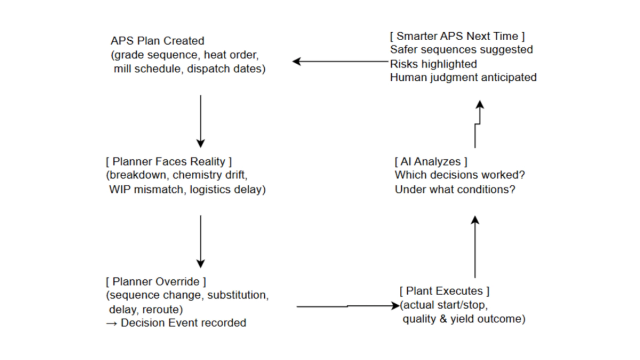
This is where AI introduces a genuine paradigm shift —not by optimizing plans harder, but by changing how order balancing itself is understood.
The Traditional View: Order Balancing as Bookkeeping
Historically, order balancing in steel has been treated as a deterministic accounting exercise.
At its core, the logic is simple:
- Required quantity versus available quantity
- Allocated plus expected supply greater than or equal to demand
- Orders flagged as balanced or unbalanced
This approach assumes a world where:
- Yields behave as planned
- Routes are stable and predictable
- Early commitment reduces risk
- Overproduction is an acceptable insurance policy
In such a world, balancing is about keeping numbers aligned.
But modern steelmaking no longer fits this model.
Why the Old Paradigm Breaks Down in Modern Steel Plants
Today’s steel producers operate in an environment defined by complexity and uncertainty:
- Make‑to‑Stock strategies are widely used to stabilize furnaces and mills
- FG swapping is routine, not exceptional
- Multiple SMS–HSM–CRM routes provide flexibility, but also competition for material
- Long lead times magnify the cost of early mistakes
- Yield losses and quality events cluster rather than average out
Under these conditions, traditional balancing logic creates an illusion of control. Screens show balance, while the shop floor accumulates stress.
The result is a fragile system:
- Excess inventory masks real shortages
- Early route lock‑in destroys flexibility
- Late re‑routing destabilizes schedules
- Planners fight symptoms instead of causes
What’s missing is not better math. It’s a better mental model.
The AI Paradigm Shift: From Balance Checks to Balance Stability
AI reframes the problem by changing the fundamental question.
Instead of asking:
“Is this order balanced right now?”
AI asks:
“How likely is this balance to survive until delivery?”
This single shift changes everything.
Order balance is no longer a static condition. It becomes a dynamic state— something that evolves and is constantly exposed to risk.
With AI, balancing becomes:
- Probabilistic, not binary
- Forward‑looking, not retrospective
- Systemic, not order‑local
- Continuously maintained, not periodically reconciled
In practical terms, order balancing moves from quantity control to stability management.
Make‑to‑Stock: From Habit to Controlled Strategy
Most steel producers rely on Make‑to‑Stock production to:
- Stabilize high‑capital equipment
- Enable rolling campaigns
- Reduce changeover losses
Traditionally, overproduction is justified as “being safe.” The real question — whether that material will ever be absorbed — is answered much later, often painfully.
AI introduces discipline without rigidity.
By learning historical absorption patterns and demand volatility, AI helps distinguish:
- Healthy strategic buffers from silent excess
- Intentional stretch from future write‑offs
Overproduction does not disappear. It becomes a calculated hedge, not an inherited habit.
Multiple Routes: Optionality as an Asset, Not a Problem
Large steel plants invest heavily in routing flexibility:
- Parallel steel melt shops
- Multiple hot strip mills
- Alternative cold rolling lines
Strategic expansion plans within a location make it even more complex.
This optionality is expensive to build — and easy to destroy.
Traditional planning logic often locks routes early to reduce complexity. When reality intervenes, the system pays the price through re‑routing, re‑allocation, and schedule churn.
AI flips the logic.
Instead of treating flexibility as something to eliminate, AI treats it as an asset to be preserved. Routes are evaluated continuously based on:
- Real yield behavior
- Congestion and bottlenecks
- Quality fallout risk
Commitment is delayed until risk demands it. Flexibility is consumed deliberately, not accidentally.
FG Swapping: From Workaround to Fulfillment Mechanism
FG swapping is often viewed as an operational workaround — a necessary evil to cope with mismatches.
AI reframes it as a signal of fungible supply.
The key question shifts from:
- “How many swaps did we make?”
to:
- Did swaps reduce overall risk?
- Did they avoid reproduction?
- Did they protect the most critical commitments?
Not all swaps are good swaps. AI helps distinguish value‑adding swaps from noise.
What Changes Functionally on the Planning Floor
From Firefighting to Anticipation
AI continuously monitors weak signals:
- Yield deviations
- Quality holds
- Route congestion
- Competing demand for the same material
Planners are alerted to future fragility, not just visible shortages. Problems are addressed when they are still cheap to fix.
From Early Commitment to Graduated Commitment
Hard allocations and early reservations are replaced with graduated commitment:
- Soft reservation
- Conditional allocation
- Firm lock‑in only when necessary
This preserves optionality without sacrificing accountability.
From Order Ownership to Portfolio Thinking
Planners stop optimizing one order at a time.
They manage:
- Groups of orders sharing a supply
- Trade‑offs across customers
- Risk exposure across time horizons
The unit of control shifts from the order to the system.
The Human Role Evolves — It Does Not Disappear
AI does not replace planners.
It removes low‑value work:
- Manual reconciliation
- Late crisis response
- Repetitive replanning
And elevates planners into roles focused on:
- Stability and resilience
- Priority setting
- Policy definition
- Commercial judgment
In capital‑intensive, irreversible processes like steelmaking, this shift is not optional. It is essential.
Why This Matters Now
Steel producers face simultaneous pressure to:
- Improve OTIF
- Reduce inventory
- Increase flexibility
- Absorb volatility
Under traditional paradigms, these goals conflict.
AI makes them compatible — not by forcing optimization, but by reducing fragility.
The Core Takeaway
AI does not make steel planning perfect. It makes it resilient.
Order balancing stops being a backward‑looking reconciliation exercise and becomes a forward‑looking stability discipline.
For steel producers, this is not an IT upgrade. It is a shift in how operational control itself is understood.
If steel manufacturing is about managing irreversible decisions under uncertainty, then AI‑driven order balancing is about making those decisions survivable.
Conclusion
AI‑driven Order Balancing does not eliminate uncertainty in steel manufacturing; it makes the system less fragile in the face of it. By reframing balance as a dynamic, probabilistic state and by equipping planners with early warning signals and structured flexibility, steel producers can achieve higher delivery reliability, lower hidden inventory risk, and more stable operations.
Disclaimer: The contents and views expressed in this article are purely personal in nature.