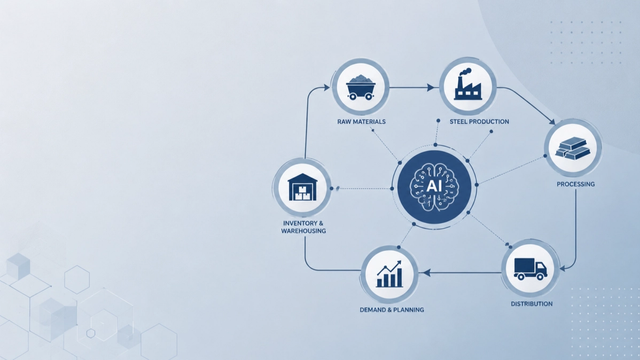
Accelerating Steel Innovation with AI: Strategies for Success
Integrating AI for Competitive Advantage in the Steel Industry
Artificial intelligence is reshaping the steel industry. As global demand continues to grow and competitive pressures intensify, steel manufacturers are looking for new ways to improve efficiency, reduce waste, optimize production, and make faster, data-driven decisions.
AI offers significant opportunities across the value chain, from predictive maintenance and quality control to supply chain optimization and production planning. Yet many organizations struggle to move beyond pilot projects and achieve meaningful business impact.
Successful AI adoption requires more than technology. It demands strong leadership, effective change management, workforce development, and a commitment to continuous improvement.
This article explores the key factors that enable steel companies to successfully integrate AI and turn innovation into measurable business results.

Executive Sponsorship and Strategic Alignment
AI initiatives succeed when they are directly connected to business objectives and actively supported by leadership.
Executive sponsorship extends far beyond budget approval. Leaders must establish a clear vision for how AI supports organizational goals and consistently communicate why these initiatives matter. Visible leadership involvement signals that AI is a strategic priority rather than a short-term experiment.
"Executive sponsorship in AI initiatives is not just about writing checks; it's about leading the charge from the front and inspiring your team to follow."
The most effective organizations focus AI investments on solving business challenges such as reducing downtime, improving product quality, increasing throughput, or strengthening supply chain performance. When AI initiatives are aligned with measurable business outcomes, adoption becomes easier and results become more meaningful.
Leadership also plays a critical role in creating an environment where innovation can thrive. AI implementation involves experimentation, learning, and occasional setbacks. Organizations that treat these experiences as opportunities for improvement are far more likely to sustain long-term progress.
Finally, executives must invest in workforce readiness. As AI capabilities expand, employees need the skills and confidence to work effectively alongside new technologies. Leadership commitment to training and development helps ensure that transformation benefits both the organization and its people.
Managing Organizational Change
AI adoption is ultimately a people transformation as much as a technology transformation.
Organizations often underestimate the challenges associated with changing established processes and ways of working. Employees may be uncertain about how AI will affect their roles or whether automation will reduce opportunities for advancement.
Clear communication is essential. Leaders should explain not only what is changing but why the change is necessary and how employees will benefit. When teams understand the purpose behind AI initiatives, resistance decreases and engagement improves.

Effective change management includes:
- Communicating a clear vision and expected outcomes.
- Engaging employees early in the transformation process.
- Providing role-specific training and support.
- Creating channels for feedback and discussion.
- Celebrating early successes to build momentum.
Organizations should also encourage collaboration across departments. AI initiatives often affect multiple functions simultaneously, and cross-functional teams can identify opportunities and challenges that may otherwise be overlooked.
By combining transparency, employee engagement, and continuous learning, companies can build the trust necessary for successful AI adoption.
Building AI Capabilities and Skills
Technology alone does not create competitive advantage. Skilled people do.
As AI becomes increasingly integrated into manufacturing operations, organizations must develop both technical and analytical capabilities across the workforce. Employees need to understand how AI systems function, how to interpret their outputs, and how to apply insights to improve decision-making.
An effective upskilling strategy typically includes:
- Assessing current workforce capabilities.
- Identifying critical skill gaps.
- Developing role-specific learning paths.
- Leveraging external expertise when needed.
- Measuring training effectiveness and business impact.
Beyond technical knowledge, employees should strengthen problem-solving, critical thinking, and data literacy skills. These capabilities enable teams to collaborate effectively with AI systems and uncover new opportunities for innovation.
Organizations that prioritize workforce development position themselves to maximize the value of AI investments while creating a more adaptable and future-ready workforce.
Measuring Impact and Scaling Success
The value of AI should be measured through business outcomes rather than technology adoption alone.
Before launching initiatives, organizations should establish clear performance indicators tied to strategic objectives. Common metrics include equipment uptime, production efficiency, product quality, energy consumption, maintenance costs, and inventory optimization.
Measurement should not end after implementation. AI systems require ongoing monitoring, evaluation, and refinement to maintain performance and adapt to changing operating conditions.
"The challenge is not just to integrate AI, but to continuously refine it, ensuring it adapts to the ever-changing landscape of the industry."
Successful organizations create feedback loops that allow teams to:
- Track performance against established goals.
- Identify opportunities for improvement.
- Retrain and refine AI models when necessary.
- Scale successful use cases across the business.
Continuous evaluation ensures that AI investments remain aligned with business needs and continue delivering value over time.
Conclusion
AI has the potential to transform the steel industry, but technology alone is not enough. Sustainable success depends on leadership commitment, organizational readiness, workforce development, and a disciplined approach to measuring results.
Steel manufacturers that align AI initiatives with business objectives, engage employees throughout the transformation process, and continuously refine their approach will be best positioned to improve performance, accelerate innovation, and maintain a competitive advantage in an increasingly data-driven industry.
#AI #SteelIndustry #Innovation #DigitalTransformation #OperationalExcellence
Disclaimer: The views expressed in this article are personal in nature, for informational purposes only, and do not constitute professional, operational, or financial advice for specific manufacturing facilities.
Further reading
- AI for Change Management
Prosci
This resource emphasizes a people-centric approach to AI adoption, providing strategies that can help the steel industry effectively manage change during AI integration.
- How AI is used in change management
IBM
This article outlines how AI can enhance change management processes, which is essential for the steel industry's successful integration of AI technologies.
- AI Projects Success Metrics To Track in 2025
CONTENTVERSE
This resource provides insights into key performance metrics for AI projects, which can help the steel industry measure the success of their AI integration efforts.
- Best AI Change Management Strategies for AI Rollout
AIRIODION GROUP CONSULTING
This guide offers practical strategies for managing change during AI implementation, which is vital for the steel industry's transition to AI technologies.
- Sustainability Indicators 2025 Report
WORLD STEEL ASSOCIATION
While not exclusively about AI, this report provides valuable data on industry performance metrics, which can inform AI integration strategies in the steel sector.