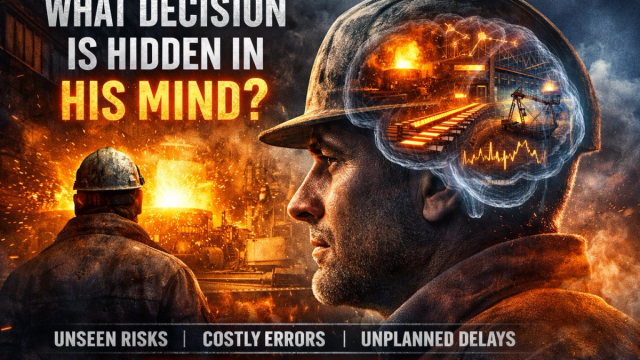
The Digital Heat is On
Namaste Readers!
For decades, the Indian steel industry has been built on the "gut feel" of veteran blast furnace operators and the sharp eyes of quality inspectors. We’ve survived fluctuating coking coal prices, global supply chain shocks, and the intense push for Green Steel. But today, a new variable has entered the mill: Artificial Intelligence.
However, there is a massive misunderstanding in our boardrooms and breakrooms. Many believe that "AI Readiness" means buying expensive software. It is not. True AI Readiness is AI Literacy—the ability of our people, from the crane operator to the plant head, to understand, challenge, and co-exist with algorithms.
In this edition, we break down what AI Literacy actually looks like in "Steel Parlance."
1. The Definition: What is AI Literacy in a Steel Plant?
In our industry, AI Literacy isn’t about writing Python code or being able to compile a complex code generated by AI. It is Operational Intuition Augmented by Data. It is the transition from “I think the heat is too high” to “The model predicts a 15% probability of a breakout, but I can see the cooling water pressure is surging—I’m overriding the AI.”
The Four Pillars of Steel AI Literacy
- Probabilistic Thinking: Shifting from “Yes/No” to “Likely/Unlikely.”
- Data Hygiene: Understanding that if the ladle sensor is dusty, the AI’s advice is “Kachra” (Garbage).
- Explainability: Asking why the AI recommended a specific scrap mix.
- Human Agency: Knowing that the human remains the “Ustaad” (Master) of the machine.
2. The AI Literacy Rubric: Team-by-Team Breakdown
AI impacts every department differently. Here are examples of how we measure literacy across the value chain:

3. A Deep Dive into the Roles
A. The Schedulers: The Chess Players
In many mills, scheduling is still done on massive Excel sheets or even whiteboards. AI can optimize 10,000 variables in seconds.
- The Literate Step: A literate scheduler doesn’t just “hit print.” They look at the Constraints. If the AI suggests a high-speed run on the Rolling Mill, the literate scheduler checks if the downstream finishing line can handle the volume.
B. Operations: The “Aankh-Kaan” (Eyes and Ears)
The furnace doesn’t lie, but sensors sometimes do.
- The Literate Step: If the AI recommends increasing oxygen lancing, but the operator hears a specific “thrum” in the vessel that indicates slag foaming, literacy is the confidence to say: “The AI doesn’t have an acoustic sensor here; I will trust my ears this time.”
C. Maintenance: From “Theek Karo” to “Pehle Socho”
We are moving from Reactive (Fix it when it breaks) to Predictive.
- The Literate Step: A technician sees a “Red” health score on a motor. Instead of just replacing it, they check the Confidence Interval. If the confidence is 90%, they pull the part. If it’s 40%, they check the sensor alignment first.
4. The Reality Check
We must be honest. AI Literacy faces three major hurdles:
- The “Black Box” Syndrome: If operators don’t understand why an AI makes a decision, they will either follow it blindly (dangerous) or ignore it entirely (wasteful).
- Data Quality: Many older plants have “analog” sensors or manual logbooks. You cannot build a 2026 AI on 1990 data.
- The Fear of Job Loss: We must communicate that AI is a “Digital Junior Engineer” – it does the calculations so the “Senior” (the human) can make the decision.
5. Implementation Strategy for 2026
How do we actually train our workforce?
- Gamification: Create “Man vs. Machine” contests in the control room to see who predicts the endpoint carbon more accurately.
- Data Literacy Bootcamps: Not for coding, but for “Data Visualization.” Teaching teams how to read a Pareto chart or a Trend line.
- Feedback Loops: Every time an operator overrides an AI, they must record why. This is the ultimate form of literacy – teaching the machine.
The Final Word
In the steel industry, toughness is a virtue. But in the age of AI, flexibility is our new strength. AI Literacy is not a luxury for the IT department; it is a survival skill for every person wearing a hard hat.
We don't need our metallurgists to become data scientists. We need them to become Data-Driven Metallurgists.
What are your thoughts? Is your plant ready to move beyond the dashboard? Let’s discuss in the comments below.
[personal post]