Look, everyone's talking about digital transformation in steel. And honestly? They should be. But here's what bothers me: most of these conversations happen in conference rooms with spreadsheets and no one's actually spent a day on a production floor watching molten steel flow through a rolling mill. That's where the real story starts.
The integration of AI into steel manufacturing isn't a luxury anymore, it's table stakes. Companies that figure this out will thrive. Those that don't? They'll be watching from the sidelines wondering what happened. And the gap between the two is widening faster than anyone predicted.
Learning from the Ground Up (Not from PowerPoint Decks)
Here's the thing nobody tells you: you can't effectively implement AI in steel production if you don't understand steel production. Revolutionary, I know.
But seriously, implementing AI in a blast furnace or a rolling mill is nothing like deploying a chatbot. The complexity is wild. Hot rolling mills don't care about your algorithm; they care about temperature differentials, coil thickness, and whether your slabs are sequenced correctly before the RHF (Reheating Furnace). Miss these details, and your AI solution becomes an expensive paperweight.
Smart engineers build beautiful machine learning models in isolation, then crash them against reality and wonder why they don't work. The answer is usually: because nobody asked the plant manager. Because nobody spent time watching how things actually work when the pressure is on and the production line is running hot, literally and figuratively.
Immersing yourself in steel operations is like learning a native language. Once you understand the rhythm, the jugalbandi of equipment, workflows, and constraints, you start seeing where AI can actually make magic happen.

Take predictive maintenance. Yeah, it sounds sexy. But it only works if you've actually sat with technicians, learned what noises mean what, understood what the historical data really represents. Without that foundation, you're building on sand.
The real insight: empirical learning teaches you how to spot problems before they become disasters. A manager who's spent time on the factory floor knows what could go wrong in ways an algorithm never will. They anticipate bottlenecks, foresee cascading failures, understand the sabab-o-natija (cause and effect) of production decisions in ways a model trained on clean data simply can't.
I've spent a lot of time on the shop floor, and what I've learned there: the real, visceral understanding, is worth more than years of theory or listening to senior engineers explain things from behind a desk. And this isn't just for senior folks. Junior team members need to get their hands dirty too. They need to sweat it out near the furnaces, feel the heat, understand the constraints and pressures that shape every decision. That's not optional. That's how you build intuition. That's how you understand what you're actually working for - not as an abstract problem, but as a real production line with real consequences.
When teams actually work at the intersection of AI and steel production, bringing their different perspectives and experiences, something clicks. You get solutions that aren't just theoretically sound; they're practically brilliant. And they stick around because people actually want to use them. Because they've seen the problems firsthand.
In an industry where conditions change constantly and variables multiply faster than you can count, relying solely on simulations is a recipe for disappointment. Firsthand experience lets you catch the subtle, vital details that no algorithm captures on its own. That's the backbone of robust AI systems.
Transforming Data into Action (Where AI Actually Earns Its Keep)
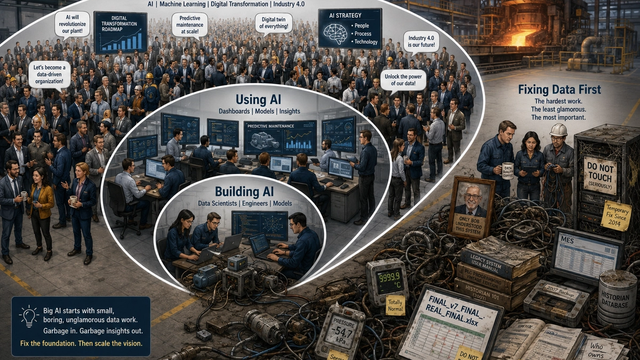
Steel plants generate mountains of data. Sensors on rolling mills, furnace temperatures, energy consumption, supply chain logistics, equipment vibrations… the list goes on. And most of it just sits there, underutilized, like a goldmine nobody bothered to mine.
The challenge isn't getting data. The challenge is turning it into something that actually changes how you operate.

This is where AI stops being a buzzword and starts being useful. You can feed an AI system the production line data, and it'll spot inefficiencies humans would take weeks to find, if they found them at all. You get actionable insights: reduce cooling time by 2%, adjust coil tension by 1.5%, sequence this order differently. Suddenly, you're eliminating waste and boosting output in measurable ways.
And maintenance? Predictive maintenance powered by IoT sensors and machine learning isn't science fiction…it's already happening in forward-thinking plants. Instead of waiting for equipment to fail catastrophically (and take production down with it), you know when maintenance is needed before the breakdown happens. Downtime drops. Profitability climbs. In an industry where every hour of downtime costs real money, that's not trivial.
Beyond the factory floor, data-driven decision-making reshapes strategy entirely. Track market demand patterns, anticipate price swings, adjust production rates accordingly. Instead of overproducing and eating the cost, or coming up short and disappointing customers, you respond with agility. You become reactive instead of reactive.
As Tim Berners-Lee said: "Data is a precious thing and will last longer than the systems themselves." That hits different in an industry like steel, where margins are thin and errors are expe. Cannsive. Data is capital. Using it well? That's the difference between survival and dominance.
But here's what matters most: technology is just the enabler. The real work is organizational. Can you adapt? Can you change how decisions get made? Can you actually use what AI tells you? Because having insights and acting on them are two completely different things.
The Future of Steel and AI (Where Things Get Interesting)
The next decade in steel will be defined by whoever figures out AI integration first. Not theoretically… actually. In production environments. And at scale.
Think about predictive maintenance scaled across an entire integrated steelworks. You catch failures before they happen. Equipment lasts longer. Production becomes predictable and reliable. That's a serious competitive advantage. Just on reliability alone, you're looking at sustained gains.
Supply chain optimization is another frontier. AI-driven demand forecasting, inventory management tuned to just-in-time precision, waste reduction…this isn't future stuff anymore. Companies doing this now are already outpacing competitors. They're reducing inventory carrying costs, dodging supply disruptions, and moving product faster.
Quality control is about to get a complete overhaul. Real-time analysis of manufacturing parameters, immediate detection of anomalies, automatic adjustments, you're not just catching problems; you're preventing them. Customers get consistently better products. Your reputation and brand value climb.
And then there's sustainability. Steel production is energy-intensive and emissions-heavy. AI can optimize energy consumption by learning usage patterns, spotting waste, suggesting adjustments. You reduce your carbon footprint while cutting costs. Win-win. In a world where environmental responsibility matters: to regulators, customers, and investors, this matters.
The takeaway isn't complicated: hands-on experience is non-negotiable for making AI work in steel. Not because theory doesn't matter, but because the gap between theory and reality in steel production is enormous. The practitioners who bridge that gap…who understand both the operational realities and what AI can do, they're the ones who'll lead the next wave of innovation.
The marriage of AI and steel is still early. But the potential is enormous. And the winners won't be the companies with the fanciest algorithms. They'll be the ones who understood the steel first, then layered AI on top of that understanding. That's the real magic.
So, what's your take? How do you see AI reshaping industries like steel? And more importantly—do you think traditional manufacturing can move fast enough to keep up? Drop your thoughts below.
P.S. – If you're dealing with operational complexity in steel, the bottleneck isn't usually the technology. It's usually the people understanding both the business and the tech simultaneously. That's rarer than you'd think. But when you find those people? That's when things actually change.
#AI #SteelIndustry #Innovation #Manufacturing #OperationalEfficiency
Disclaimer: The views expressed in this article are personal in nature, for informational purposes only, and do not constitute professional, operational, or financial advice for specific manufacturing facilities.