Manufacturing AI is often described as a journey from predictive to prescriptive to agentic. The language suggests a neat progression: first the system predicts, then it recommends, and eventually it acts.
Real factories do not experience the journey so neatly.
An operator does not wake up one morning to discover that the plant has become agentic. A planner receives an earlier warning. A quality engineer sees a pattern before a batch fails. A maintenance team receives a better-prepared work order. A production manager gets a comparison of recovery options before the meeting begins.
The transition happens through a series of small changes in what the system enables people to do.
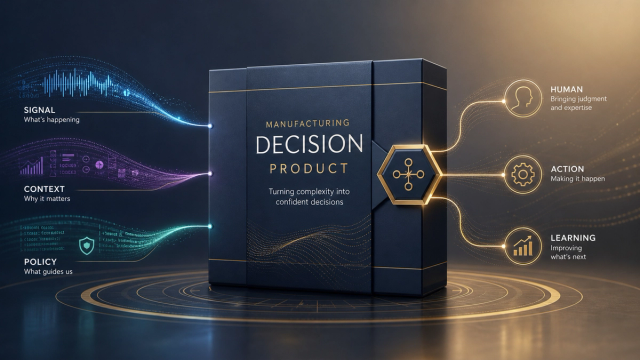
That is why the most useful way to think about AI maturity is not as a technology switch, but as a ladder of actionability… notice, explain, compare, prepare, recommend, approve, and execute. Each step demands stronger evidence, clearer authority, and a more reliable connection to the real work.
FAQ targets
By the end of this chapter, you must have answers for these questions:
- What does predictive to prescriptive to agentic manufacturing AI mean for manufacturing leaders?
- How can organisations apply this idea in manufacturing?
- What role do people and governance play?
- How can success be measured?
The situation people actually experience
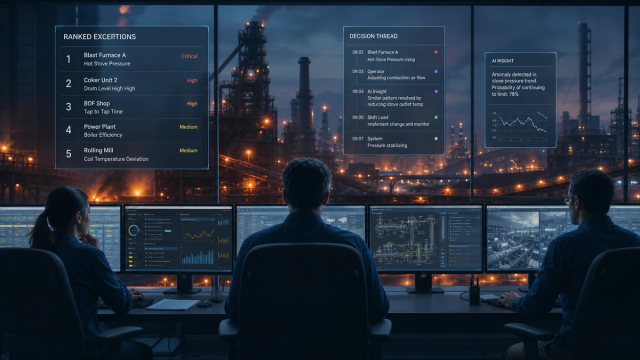
Imagine an integrated steel plant producing a customer-specific grade. The line is running normally, but a combination of temperature, speed, and surface signals begins to look unusual. An AI model estimates that the probability of a quality deviation has increased.
What should happen next?
The answer is not automatically “stop the line.” Stopping may protect quality, but it may also create a production disruption, affect several orders, and consume a valuable sequence position. Continuing may preserve flow, but it may increase rework or produce material that cannot be released.
At the predictive level, the system can say:
“This pattern resembles conditions associated with a quality deviation.”
That information may already be valuable. It gives the operator time to inspect. It gives quality time to prepare a targeted test. It gives the planner time to identify affected orders. It gives the shift in charge time to consider whether the next safe pause is sufficient.
At the prescriptive level, the system might compare three choices:
- continue while increasing inspection frequency;
- slow the process and perform a controlled check;
- stop at the next safe point and investigate fully.
At the agentic level, the system might gather the evidence, prepare the inspection request, notify the responsible roles, and place a draft hold on the affected batch. Whether it may execute any of those actions depends on the authority designed around the use case.
The value does not come from the autonomy label. It comes from the decisions unlocked while useful choices remain available.
The central argument
Manufacturing AI should mature through demonstrated actionability rather than through increasingly impressive language about autonomy.
A useful capability answers progressively better questions:
1. Notice: What is changing?
2. Explain: Why might it matter?
3. Compare: What options are available?
4. Prepare: What evidence and workflow are needed?
5. Recommend: Which option appears strongest, and under which assumptions?
6. Approve: Who has the authority to accept the recommendation?
7. Execute: Which bounded action may the system take?
The higher the rung, the greater the burden of proof. A system that notices an unusual signal can tolerate more uncertainty than a system that changes a production sequence. A system that prepares a draft can be given more limited authority than one that stops a line or releases material.
The practical test is therefore simple:
“What is the lowest level of assistance that improves this decision safely and measurably?”
That question protects the organisation from two opposite mistakes: demanding full autonomy before the basics are reliable, or keeping a useful capability trapped in an unhelpful alerting stage.
The actionability ladder
1. Notice: bringing attention to change
The predictive system identifies a shift from expected behaviour. This could be a rising probability of equipment failure, a likely delay, abnormal energy consumption, supplier risk, demand change, or quality concern.
The quality of a notice is not determined only by model accuracy. Timing matters. A highly accurate prediction that arrives after the decision window is over may be less useful than a moderately accurate signal that arrives early enough to investigate.
The user also needs to know what the notice refers to. “Risk increased” is weak. “Coil 24-7-9821 on Mill 2 is showing a pattern associated with surface deviation; inspection is still possible before the next campaign change” is more actionable.
2. Explain: connecting the signal to meaning
Explanation is not a decorative paragraph beside a score. It is the bridge between model output and human judgement.
The system should identify the evidence it used, the evidence it did not have, the comparison period, and the conditions that influenced the result. It should distinguish correlation from confirmed cause.
An operator does not need a mathematical lecture during a difficult shift. They need to know whether the signal matches something they recognise, whether the situation is urgent, and what should be checked before acting.
3. Compare: making choices visible
Prescriptive support begins when the system can compare feasible alternatives.
For a late order, it might compare resequencing, alternate material, split shipment, expediting, customer renegotiation, and waiting. For a maintenance concern, it might compare continued operation with increased monitoring, a controlled pause, or immediate intervention.
The comparison must show what each option protects and consumes. An option that improves on-time delivery may increase changeover loss. An option that protects asset health may create a customer delay. An option that looks cheapest may consume the last available recovery window.
A recommendation is not useful if it hides the trade-off inside a single ranking.
4. Prepare: reducing the work around the decision
Preparation is often underestimated. A system may not be ready to recommend or execute, but it can still remove a great deal of coordination effort.
It can gather the relevant order history, retrieve the operating procedure, assemble the affected assets, prepare a quality request, draft a customer update, or create a proposed schedule change. It can identify the people who must review the case and the time by which a decision is needed.
Preparation is valuable because many operational delays are caused not by difficult reasoning but by the time required to assemble the case.
5. Recommend: supporting judgement without disguising uncertainty
A recommendation should be explicit about its confidence, assumptions, constraints, and consequences. It should also be possible to challenge.
The system might say:
“Recommend slowing the line for a controlled inspection because the quality signal is increasing, the affected material is not yet packed, and the next customer commitment has a twelve-hour buffer. This recommendation depends on inspection capacity being available during the current shift.”
That is more useful than “Recommended action: slow line.”
6. Approve: making authority meaningful
Approval is not simply the presence of a button. The reviewer needs enough time, context, and authority to make a real choice.
If a manager receives an approval request after the production sequence has already moved, the approval is ceremonial. If the user cannot understand the consequences, the approval is unsafe. If rejecting the recommendation requires a long justification while accepting requires one click, the workflow quietly biases the outcome.
7. Execute: bounded action in the real workflow
Execution is the highest rung because the system’s decision enters the physical and commercial world.
An agent may be allowed to create a draft work order or notify a defined team. It may not be allowed to change a safety setting, release questionable material, alter a contractual customer commitment, or stop a process without the authority and controls required by the situation.
Executable actions should be narrow, observable, logged, and reversible where possible. The system must have a clear stop path and a defined response when the world changes after execution.
Why prediction often fails to create value
Many AI pilots stop at prediction because the organisation has not designed what happens next.
The model identifies a risk, but no one owns the response. The alert arrives, but the relevant order or asset is not identified. The confidence score is visible, but the consequences of acting are not. The team receives another dashboard but still calls the same experienced planner to decide what it means.
This is not necessarily a model problem. It may be a decision-design problem.
Ask:
- What decision does this prediction unlock?
- Who is expected to act?
- How much time remains?
- What choices are available?
- What evidence would change the recommendation?
- What should happen when the model abstains?
If these questions have no answer, improving model accuracy may not improve the operation.
When prescriptive advice is not usable
Prescriptive systems can fail even when their calculations are correct.
They may recommend an impossible sequence because they do not know the actual changeover condition. They may recommend a partial shipment that is commercially useless. They may choose a lower-cost option that violates a customer-specific quality requirement. They may recommend a maintenance action without considering the availability of skilled labour or a safe isolation window.
The diagnostic question is not merely “Was the recommendation mathematically optimal?” It is:
“Could the person responsible actually carry out this recommendation under the conditions of the shift?”
Usability is part of decision quality.
When agentic action is premature
Agentic systems can gather information, reason across tools, and prepare or execute actions. That creates value, but it also creates new failure modes.
An agent may call the wrong tool because two systems use similar terms. It may carry an outdated assumption from an earlier conversation. It may perform a technically valid action in the wrong plant or for the wrong order. It may continue a workflow after a human assumption has changed.
Before granting authority, test the agent with:
- missing data;
- conflicting system statuses;
- stale documents;
- unusual shift conditions;
- ambiguous user requests;
- unsafe shortcuts;
- attempts to exceed permissions;
- and situations where the correct answer is “not enough evidence.”
The agent should be judged not only by how often it acts correctly, but also by how safely it stops, asks, and escalates.
Architecture for actionability
The architecture should follow the ladder.

Signal layer
Collect the operational events and measurements needed to recognise change. Make source, freshness, and ownership visible.
Interpretation layer
Connect signals to the affected order, asset, customer, process, or project. Explain what the signal means and what it does not prove.
Option layer
Represent feasible actions, hard constraints, soft preferences, consequences, and decision windows.
Workflow layer
Route preparation, recommendation, approval, escalation, and execution to the correct roles. Keep the action path connected to the person who carries the consequence.
Learning layer
Record recommendations, choices, overrides, outcomes, and reasons. Without this loop, the organisation cannot know whether it is moving upward on the actionability ladder or merely changing terminology.
A practical 90-day sequence
Days 1–30: Select the right rung
Choose one recurring decision and ask what level of assistance would materially improve it. Do not start with the ambition to build an autonomous agent. Start with the decision window, the consequence of delay, the available options, and the safest useful intervention.
Interview the people who notice the signal, interpret it, act on it, and live with the outcome. Record where the decision currently waits.
Days 31–60: Build an action card
Create a human-readable view that shows the signal, affected case, explanation, options, assumptions, owner, deadline, and next action. Keep recommendations separate from execution.
Test historical cases. Ask users whether the system would have helped them act earlier and whether the suggested options were genuinely feasible.
Days 61–90: Run in shadow mode
Allow the system to prepare predictions, explanations, comparisons, or recommendations without changing the operation. Compare them with human decisions and outcomes.
Measure warning time, time to understand, time to choose, option quality, override reasons, user comprehension, and recovery results.
After 90 days: Move upward deliberately
Move from notice to explain, or from recommend to approve, only when the evidence supports the next level. Authority should be earned by observed performance, not by a project milestone.
Questions for leaders
- What is the lowest rung that would improve this decision?
- Is the prediction arriving early enough to matter?
- Can users see the evidence and assumptions behind the recommendation?
- Are the proposed actions feasible in the real operating environment?
- What happens when the system lacks enough evidence?
- Is approval genuine or ceremonial?
- Which actions are safe to automate, and which must remain human-controlled?
- What would justify moving to the next level of authority?
Conclusion: autonomy is the result, not the starting point
The mature question is not, “When will we reach autonomous AI?” It is:
“Which level of assistance is justified for this decision, today?”

Some decisions need earlier warning. Some need better explanation. Some need a comparison of alternatives. Some need preparation that removes hours of coordination. A smaller number may eventually justify bounded execution.
The most valuable AI system may therefore be the one that does not look autonomous at all. It may simply help a planner see a conflict earlier, help an operator understand a risk, help quality prepare the right test, or help a manager choose before the remaining options disappear.
Actionability is earned one decision at a time. Begin at the lowest rung that changes the outcome. Measure what improves. Learn from disagreement. Increase authority only when the organisation understands the consequences.
That is how manufacturing AI becomes dependable: not by moving quickly toward autonomy, but by moving carefully toward useful action.
Disclaimer
Industry situations in this chapter are composite illustrations unless explicitly attributed to a public source. They are not claims about any particular company, plant, vendor, or incident. Implementations must be validated against local safety, quality, cybersecurity, regulatory, contractual, labour, and data-governance requirements.
#PredictiveAI #PrescriptiveAI #AgenticAI #ManufacturingAI #AIAdoption #OperationalIntelligence #DecisionIntelligence #SmartManufacturing #IndustrialAI #AITransformation