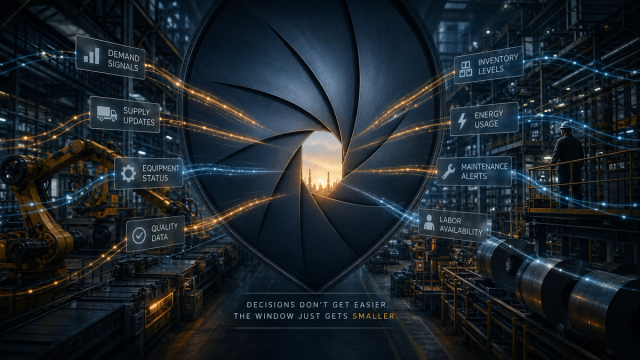
A decision product is more than a dashboard feature. It is a persistent capability designed around a recurring choice.
It has users, a service level, evidence, failure modes, ownership, and a way to improve from outcomes. It is something the organisation depends on during real work, not something demonstrated once during a technology presentation.
This distinction matters because manufacturing organisations have accumulated many dashboards. Some are useful. Many are opened during meetings, screenshotted for reports, or ignored until a problem becomes impossible to miss. The issue is not that dashboards are inherently bad. It is that a dashboard can show the condition of the business without helping anyone decide what to do next.
A decision product begins at the moment of choice.
FAQ targets
By the end of this chapter, you must have answers for these questions:
- What does the rise of decision products mean for manufacturing leaders?
- How can organisations apply this idea in manufacturing?
- What role do people and governance play?
- How can success be measured?
The situation people actually experience
Imagine a promise-recovery capability in an integrated steel plant. A customer order is likely to miss its committed dispatch window. The planner needs to know which production sequences remain feasible. Customer service needs a defensible confidence level and a time for the next update. Internal logistics needs to know whether a partial bundle can be moved. Quality needs to confirm what is genuinely releasable. Management needs to understand the commercial and operational trade-off.

There is one underlying decision, but several users experience it differently.
The planner does not need the same screen as customer service. The planner needs sequence and capacity alternatives. Customer service needs a clear explanation that can be responsibly communicated. Management needs exposure, authority, and consequence. If one generic dashboard is expected to satisfy all three, it may satisfy none of them.
The product must be designed around the decision and the roles that participate in it.
The central argument
A decision product is a managed operational service that helps people make a recurring choice with better context, better timing, and better learning.
It should define:
1. The decision: what must be chosen, not merely what must be observed.
2. The users: who notices, interprets, recommends, approves, executes, and lives with the outcome.
3. The trigger: what causes the product to become relevant.
4. The service level: how quickly the product must respond and how fresh its evidence must be.
5. The options: which choices are genuinely feasible.
6. The authority: who can accept, reject, override, or escalate.
7. The outcome: how the organisation will know whether the decision improved.
8. The learning loop: how overrides, errors, and outcomes will change the product.
This is why a decision product is not simply an AI model wrapped in a user interface. It includes the workflow, operating agreement, evidence, ownership, and learning mechanism around the model.
From dashboard to decision product
Consider the difference between two statements.
Dashboard statement
“Orders at risk: 18.”
Decision-product statement
“Seven customer orders may miss their dispatch windows within the next 48 hours. Three can be recovered through resequencing. Two require quality-release confirmation. One depends on a fixed truck slot. The planner must choose a recovery path by 14:30, and customer service should not issue a revised date until the quality status is confirmed.”
The second statement is more demanding because it must connect data to a decision. It must know what “at risk” means, understand the customer completion rule, identify feasible options, and route the next action.
The dashboard counts. The decision product coordinates.
What users actually need
The planner
The planner needs a trustworthy view of the decision window, material and capacity constraints, sequence alternatives, and consequences. A recommendation that ignores changeover realities or customer bundle requirements will quickly be rejected.
The operator
The operator needs an explanation that relates to the physical process. They need to know what has changed, what to check, and whether the proposed action is safe within the operating procedure. They should not be asked to interpret a business score with no connection to the line.
The quality professional
Quality needs clear status semantics, evidence lineage, and authority boundaries. “Produced” must not silently become “released.” The product should show what evidence is complete, what remains uncertain, and which disposition options are permitted.
Customer service
Customer service needs confidence that is honest enough to communicate. A customer update should not be based on the latest optimistic estimate. It should distinguish confirmed, at risk, awaiting evidence, and recovery under review.
Management
Management needs the portfolio view: which promises are exposed, what choices remain, what each choice protects or costs, and which decisions require leadership intervention.
The product can serve all these roles, but it should not assume that one view is the right experience for everyone.
A decision product has a service level
Manufacturing teams are accustomed to service levels for equipment, systems, and logistics. Decision products need them too.
Define:
- how quickly a signal should be detected;
- how soon the situation should be assembled;
- how fresh each important input must be;
- how long a user can wait for a recommendation;
- when the product must abstain;
- and what happens when the product is unavailable.
A promise-recovery product that responds after the truck has departed has failed even if its recommendation is accurate. A maintenance product that provides excellent analysis after the safe intervention window has closed has not delivered the required service.
Timeliness is part of product quality.
The product backlog is not enough
A conventional product backlog might contain items such as:
- add a new dashboard filter;
- integrate another data source;
- improve model accuracy;
- create an alert;
- add export to Excel.
These may be useful, but they are not sufficient to manage a decision product. The backlog should also contain decision-quality work:
- clarify the definition of “in full”;
- capture planner override reasons;
- show the age of the quality evidence;
- add a customer-specific completion rule;
- make the decision owner visible;
- support an abstain state;
- record whether the chosen option was executed;
- and measure whether the outcome matched the expectation.
The product team must improve the decision, not merely improve the screen.
When a decision product fails
It answers the wrong question
The product may be beautifully designed around a metric that nobody can act on. If the team cannot name the choice supported by the product, the product is probably still a reporting tool.
It arrives too late
The product detects a risk only after the best recovery options have disappeared. This is a service-level failure, not only a prediction failure.
It offers impossible options
The system proposes a sequence that violates a changeover rule, a quality hold, a labour constraint, or a physical movement limitation. Feasibility must be validated in the operating environment.
It hides uncertainty
The product shows one confident date when several conditions remain unresolved. Users learn that the confidence is cosmetic and return to personal workarounds.
It has no owner
Everyone can view the recommendation, but nobody is responsible for accepting, rejecting, or escalating it. Visibility without ownership creates passive awareness.
It treats overrides as user failure
An override may reveal missing context, a legitimate exception, a policy conflict, or an unsafe recommendation. If the product discourages overrides, it suppresses the learning needed to improve it.
It has no outcome loop
The product records recommendations but not what happened next. Without an outcome, the team cannot distinguish a useful recommendation from a lucky one.
From prediction to a usable product
Prediction can be a component of a decision product, but it is not the product itself.
Suppose a model predicts that an order has a high probability of delay. The product must connect that prediction to:
- the customer promise;
- the definition of complete delivery;
- current production and quality status;
- remaining capacity and sequence options;
- logistics and documentation readiness;
- the cost of recovery;
- the communication deadline;
- and the person authorised to decide.
The product may recommend an action, prepare the evidence, or simply ask for a missing confirmation. Its level of autonomy should be chosen according to consequence and reversibility.
The right question is not “Can the model predict delay?” It is “Can the organisation use the prediction while there is still something sensible to do?”
Architecture without abstraction
The architecture should follow the decision’s journey.

Evidence layer
Connect ERP, MES, APS, quality, logistics, maintenance, documents, sensors, and relevant human input. Record source, owner, freshness, and confidence.
Decision context layer
Assemble the affected order, asset, customer, commitment, constraint, and decision window. Make contradictory statuses visible instead of silently choosing one.
Option and consequence layer
Represent feasible alternatives and their impact on delivery, cost, quality, safety, capacity, inventory, and future flexibility.
Experience layer
Provide role-specific views and explanations. A planner, operator, quality reviewer, and manager should see the information needed for their part of the decision.
Authority and workflow layer
Route recommendations, approvals, escalation, and execution. Make the owner and next action explicit.
Learning layer
Capture choices, overrides, execution, outcome, and reason. Use the record to improve the product’s evidence, rules, and user experience.
A practical 90-day sequence
Days 1–30: Define the product around one decision
Choose one recurring decision with visible cost of delay. Interview its users separately. Ask what they need, what they distrust, what they do manually, and what outcome would prove the product useful.
Write a one-page decision product charter: decision, users, trigger, deadline, evidence, options, authority, outcome, and safe failure mode.
Days 31–60: Build the minimum useful experience
Connect only the evidence required for the first decision. Design the smallest experience that shows the situation, options, owner, and next action. Allow users to challenge the interpretation and record why.
Avoid building a general platform before learning what the decision actually needs.
Days 61–90: Operate in shadow mode
Let the product assemble cases and prepare recommendations without executing them. Compare the product’s view with human decisions, overrides, and outcomes.
Measure time to understand, time to decide, option quality, recommendation clarity, override reasons, and actual operating results.
After 90 days: Fund the product, not just the pilot
Assign a product owner, domain owner, data owner, and outcome owner. Define the support rhythm, review cadence, change process, and retirement criteria. A decision product must have a life after the pilot announcement.
Questions for leaders
- What recurring decision is this product responsible for improving?
- Who are its different users, and what does each need?
- What service level does the decision require?
- What evidence must be fresh, and what evidence may be approximate?
- Which options are truly feasible?
- What does the product do when it lacks enough evidence?
- Who owns the decision when users disagree?
- How will overrides improve the product?
- What outcome will determine whether the product deserves continued investment?
- When should the product be retired or redesigned?
Conclusion: build for the moment of choice
A dashboard reports the state of the business. A decision product helps a person move the business from one state to another.
That difference is not a matter of interface design. It is a different way of thinking about value. The value of a decision product appears when a planner avoids an unnecessary escalation, when an operator receives useful context early enough to respond, when quality uncertainty is handled honestly, when customer service communicates with confidence, or when a manager sees a trade-off before it becomes a crisis.
The product does not need to automate everything. It needs to make one important decision more dependable, more explainable, and easier to improve.
Start with the choice. Design around the users. Set a service level. Make options visible. Preserve human authority. Record the outcome. Then earn the next decision.
That is how decision products become part of the operating system of manufacturing rather than another attractive object in the dashboard catalogue.
Disclaimer
Industry situations in this chapter are composite illustrations unless explicitly attributed to a public source. They are not claims about any particular company, plant, vendor, or incident. Implementations must be validated against local safety, quality, cybersecurity, regulatory, contractual, labour, and data-governance requirements.
#DecisionProducts #ProductManagement #ManufacturingAI #DecisionIntelligence #OperationalExcellence #SmartManufacturing #AIProducts #IndustrialAI #DigitalTransformation #ManufacturingLeadership