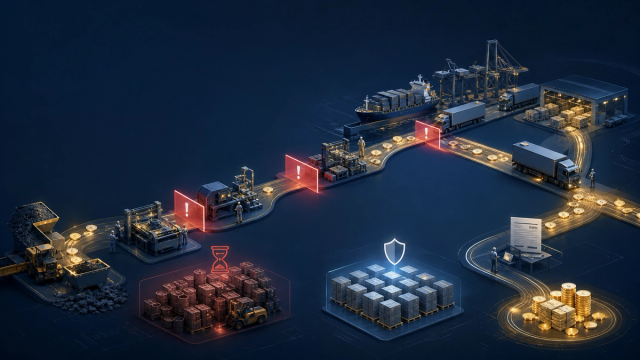
The order looked profitable when it was accepted.
The quoted price covered the material, conversion, logistics, and expected service level. The commercial team saw a healthy contribution margin and approved the commitment. The customer was important, the volume fit the plan, and the business had a reason to be confident.
Then the execution began to move.
The customer changed the mix late. A material arrived outside the preferred window. Production ran a smaller campaign than planned. A quality issue created rework. The shipment missed the normal carrier and moved by premium freight. Some finished product sat in storage because the customer’s revised schedule no longer matched the original plan.
The order was still delivered. Revenue was booked. The customer relationship was protected.
Much of the planned margin was gone.
This is the gap between planned margin and realized margin. A business can accept a profitable order and execute it in a way that consumes the economics it expected to earn. The Margin Integrity Index, or MII, makes that gap visible by connecting commercial intent to operational reality.

MII does not ask whether operations spent money. It asks whether the business model survived contact with the choices required to fulfil the promise.
Planned margin versus realized margin
Planned margin is based on assumptions. Material will arrive at a planned cost. Production will run at a planned yield. Energy will remain within a benchmark. Freight will follow the expected route. The customer will keep the agreed schedule. Quality will pass first time. Inventory will turn as expected.
Those assumptions may be reasonable. They are not guaranteed.
Realized margin reflects what actually happened. It includes late changes, inefficient campaigns, premium purchases, rework, downgrade, overtime, expedited freight, storage, concessions, and the effect of delays on customer and network decisions.
The difference is not automatically a failure. Some margin movement comes from external market conditions or a deliberate strategic choice. The management problem occurs when the bridge is invisible. Leaders see revenue and a final margin percentage but cannot explain which operational decisions changed the result.
Timing matters as well. A margin may appear healthy at shipment and weaken later through returns, warranty, storage, quality claims, rebates, or delayed cash collection. A short-term view can therefore overstate the economics of an order. MII should define the point at which margin is measured and identify downstream costs that remain open.
This does not require waiting months before acting. Early estimates can show a range of realized margin and the assumptions that drive it. If a quality concession, customer delay, or warranty cost is still uncertain, the bridge should show the uncertainty rather than hide it until the accounting period closes.
The leadership question should move from “Was the order profitable when we accepted it?” to “How much of the planned economic value survived execution, and why?”
What MII measures
MII answers a practical question:
How closely did realized contribution match the margin the business expected when it made the commitment?
The index may include:
- Planned versus realized selling price.
- Material purchase and consumption variance.
- Yield, scrap, downgrade, and rework impact.
- Energy and utility variance.
- Labor, overtime, and changeover cost.
- Freight, premium transport, and storage.
- Quality, warranty, concession, and return cost.
- Customer date or mix changes.
- Capacity displacement and opportunity cost.
- Tariff, currency, and market-price movement.
MII should preserve the distinction between controllable execution variance, customer-driven change, market movement, and deliberate strategic investment. A margin loss caused by a tariff change is different from a loss caused by avoidable rework, even if both appear in the same financial line.
The index should also be connected to customer and product criticality. Protecting a strategic account at lower margin may be the right decision, but the trade-off should be visible and approved rather than treated as an unexplained variance.
The margin bridge
A margin bridge turns the gap between planned and realized margin into a decision story.

Start with the planned margin at the time of quotation or commitment. Then explain the movement through categories such as:
- Price and commercial terms.
- Material cost and consumption.
- Product mix and campaign effect.
- Yield, scrap, downgrade, and rework.
- Energy and process efficiency.
- Labor, overtime, and changeover.
- Freight, storage, and handling.
- Quality recovery and customer concession.
- Delay, cancellation, or renegotiation.
- Currency, tariff, and market movement.
The bridge should identify whether each movement was expected, accepted, avoidable, or still under investigation. It should also identify the decision that created or prevented the movement.
For example, premium freight is not just a logistics cost. It may result from a late customer change, a quality hold, a supplier delay, a planning error, or a deliberate decision to protect an ONRI-critical promise. The right action depends on the cause.
A bridge is useful when it leads to a choice. If material variance is recurring, procurement and engineering may need to revisit sourcing or design. If overtime is caused by mix volatility, S&OP may need better CAI. If quality recovery is consuming margin, QRI and process improvement should be involved.
The profitable order that lost its economics
Consider a customer order accepted with a planned contribution margin of $240,000.

The customer changes the product mix after the production freeze, requiring a smaller campaign and an additional changeover. Material for the revised mix arrives late, so procurement pays a premium. During production, one batch fails inspection and requires rework. The original carrier window is missed, and the shipment moves by premium freight. The customer then delays part of the receipt, leaving finished goods in storage.
The order still ships and the customer is protected. But the realized margin is different:
- $35,000 lost to material premium and extra consumption.
- $28,000 lost to changeover and overtime.
- $42,000 lost to rework and quality recovery.
- $31,000 lost to premium freight and handling.
- $19,000 lost to storage and delayed movement.
- $17,000 lost through a commercial concession.
The order’s realized contribution is now $68,000 before considering broader opportunity effects. No single team created the entire gap. The margin leaked through a chain of reasonable local responses.
The lesson is not that every response should have been rejected. The order may have been strategically important, and protecting it may have been the right choice. The lesson is that the business should know the cost of the choice, approve it at the right level, and learn whether a different design could protect the same value next time.
MII helps leaders see the chain without reducing the discussion to blame.
Margin is a decision, not only a result
A margin bridge is most useful before the order is finished. If a customer change arrives, leaders should be able to compare the available responses: accept the change, reprice it, delay it, split it, substitute, expedite, or decline it. Each option has a service effect, cost effect, and relationship effect.
The decision should consider the value protected, not merely the incremental cost. Premium freight may be sensible for a launch-critical commitment and wasteful for a flexible replenishment. Rework may be justified when the customer value is high and the alternative is unavailable, but it may be uneconomic when the order can be rescheduled without consequence.
This is why MII should be connected to ONRI. Customer criticality helps leaders decide how much margin trade-off is acceptable. The index does not make the choice automatically. It gives the decision-maker a more complete view of the consequence.
Customer segmentation and margin integrity
The same service response can have different economics across customer segments.
A strategic account may justify reserved capacity, faster communication, and a narrower promise window. A transactional order may need a different service level and a different recovery rule. If the commercial model prices both commitments similarly while their cost-to-serve differs sharply, margin leakage is built into the promise.
MII can reveal repeated patterns by customer, product, region, order profile, and service tier. That evidence may support revised minimum quantities, lead times, surcharges, delivery windows, or contract terms. The goal is not to reduce service. It is to align the promise with the operating model required to deliver it profitably.
Capacity opportunity cost
Margin leakage can also occur when a recovery protects one order by consuming capacity that would have produced a higher-value order. The cost is not always visible because the displaced order may be delivered later rather than cancelled. Its margin loss appears in another period, customer, or plant report.
MII should record material displacement where it is economically meaningful. If a premium campaign takes the only available line time, leaders should understand what demand was delayed, what customer priority rule applied, and whether the trade-off was deliberate. This connects realized margin to ONRI, DFAI, and CAI rather than assigning the effect only to manufacturing.
The measure should remain practical. Not every theoretical opportunity cost needs to be calculated. Focus on constrained assets, strategic customer commitments, and repeated decisions where allocation changes the business result.
Material, yield, energy, freight, rework, and delay effects
Margin integrity is shaped by the operating details of fulfilment.
Material
Material cost can change because of market price, sourcing decision, rush purchase, specification change, or extra consumption caused by yield loss. The business should separate price variance from usage variance.
Yield
Lower yield increases material consumed per usable unit. Scrap, downgrade, and recovery may preserve some value but rarely preserve the original economic assumption.
Energy
Energy cost can move because of tariff, volume, mix, thermal performance, or process instability. The TEEI view helps identify whether the issue is operational or market-driven.
Freight
Premium freight may protect an important promise, but it can consume the order’s margin. The decision may still be right; the economic effect must be recorded.
Rework
Rework consumes capacity, labor, energy, and schedule time. It may also delay other orders or create another quality risk.
Delay
Delay can create storage, penalties, concessions, lost opportunity, and customer trust impact. It can also force the business to hold inventory longer than planned.
MII should connect these effects to the decision episode that created them.
Campaign under-fill and demand mix
Margin is often lost before a shipment leaves the plant.

A campaign planned for a certain volume may be under-filled because demand changes, material is unavailable, quality blocks a portion, or a customer delays. The fixed setup, changeover, energy, labor, and maintenance costs are then spread across fewer usable units.
Mix can create a similar effect. A shift toward small lots, premium finishes, or complex configurations may increase changeovers and reduce throughput. The selling price may rise, but the cost-to-serve can rise faster.
MII should therefore connect to DFAI and CAI. Forecast alignment reveals whether the demand mix was understood. Change agility shows how costly it was to respond. The margin bridge shows the realized economic result.
The correct action may be a different minimum order quantity, a customer-specific price, a revised lead time, a campaign rule, or a capacity reservation. Margin integrity is not only a finance calculation; it can improve the design of the commercial promise.
Renegotiation-linked margin impact
Customer and market changes often create a renegotiation moment.
A customer may request an earlier date, different configuration, smaller lot, delayed receipt, or additional service. The commercial team may accept the change to protect the relationship. If the price or terms do not change with the cost-to-serve, the business silently absorbs the difference.
Not every change should trigger a new price. Some are part of the service promise. But the organization should know which requests consume flexibility and which create economic exposure.
Useful questions include:
- What changed from the original commitment?
- Was the change inside or outside the agreed commercial terms?
- What cost and capacity consequence did it create?
- Was the customer price or date adjusted?
- Which other customer or plant commitment was displaced?
- Was the decision strategic, contractual, or simply habitual?
This is where MII supports commercial learning. Repeated margin leakage from one customer pattern may indicate that the service promise needs redesign.
Why margin optimization can weaken resilience
Margin pressure can lead leaders to remove buffers, consolidate suppliers, reduce spare capacity, or minimize inventory. These actions may improve near-term economics while reducing the ability to absorb disruption.

An alternate supplier may cost more but protect important customers during a shortage. Spare capacity may look inefficient until the primary plant fails. Buffer inventory may reduce working-capital velocity but preserve an irreplaceable commitment.
MII should therefore be read with NRI, WCVI, and ONRI. A lower cost structure is not automatically better if it increases exposure or makes the customer promise fragile. Conversely, a resilience investment should be evaluated against the margin and value it protects.
The right question is not “What is the lowest possible cost?” It is “What economic structure allows us to protect important value under realistic conditions?”
Using MII without blaming operations
Margin analysis can become a blame exercise if it begins with “who spent more than planned?”

Operations may have used premium freight because quality delayed a shipment. Procurement may have paid a higher price because the original supplier failed. Customer service may have accepted a change because the account was strategically important. Finance may have changed the standard after the fact. Each action needs context.
MII should focus on decisions, assumptions, and system design:
- Was the option available when the decision was made?
- Was the cost visible at the time?
- Who had authority to choose the response?
- Which constraint forced the decision?
- Was the decision reversible?
- Did the action protect more value than it consumed?
- What would reduce the need for the same action next time?
This approach preserves accountability without creating defensive reporting. The objective is to improve the operating system that produces margin, not to punish the team that absorbed its weaknesses.
Connecting MII to the other indices
MII is a connective measure across the framework.
ONRI shows which customer promises may justify a margin trade-off. A lower-margin recovery may be appropriate when it protects a highly consequential strategic commitment, but the choice should be visible.
DFAI shows whether demand and mix were understood well enough to build the right plan. Poor alignment can create campaign under-fill, excess inventory, and changeover cost.
YMEI shows how material consumption, scrap, downgrade, recovery, and yield affect contribution.
TEEI shows energy usage, thermal performance, rate variance, and pass-through lag.
NRI shows whether resilience options cost more today but protect future commitments. WCVI shows how inventory, receivables, and buffers affect cash.
The relationship can be summarized:
- MII: How much planned margin survived execution?
- ONRI: Which promise did the margin protect?
- DFAI: Did the demand signal support the economics?
- YMEI: What did material conversion consume?
- TEEI: What did energy and process efficiency consume?
- NRI: What resilience option was worth funding?
- WCVI: What cash and inventory consequence followed?
Governance of planned and realized margin
MII needs a stable basis of comparison.
The organization should record the planned margin at a defined point: quotation, order acceptance, production release, or another agreed milestone. If the baseline changes every time assumptions move, realized margin cannot be evaluated fairly.
Definitions should specify treatment of market price, customer changes, tariffs, currency, standard cost, allocation, shared capacity, storage, quality, and opportunity cost. The organization should distinguish a true margin loss from a reclassification or accounting timing effect.
The margin bridge should preserve the original plan, approved changes, actual cost, and reason for variance. It should show uncertainty where the cost is still being estimated. Precision should not be invented to make the result look complete.
Governance should include finance, commercial, operations, supply chain, procurement, quality, and plant leadership. Margin integrity is shared because value is created and lost across the journey.
The baseline should be auditable enough for finance and understandable enough for operators. If only specialists can explain the bridge, it will not improve daily decisions.
Questions for the executive review
Leaders can ask:
- What was the planned margin when we accepted the order?
- What is the realized margin now, and what explains the bridge?
- Which cost movements were market-driven, customer-driven, execution-driven, or avoidable?
- Did quality, yield, energy, freight, rework, or delay create the largest gap?
- Which customer promise did the recovery protect?
- Did the demand mix or campaign under-fill weaken the result?
- What resilience or inventory option would have improved the outcome?
- Are we passing through cost changes with enough speed?
- What repeated margin leakage should change commercial terms or operating design?
- What action would prevent the same leakage next time?
The review should end with an owner and a decision, not simply a post-mortem.
Start with one order journey
Choose a recently completed order that looked profitable at acceptance but finished with a material margin gap. Trace the order through customer changes, materials, production, yield, quality, energy, freight, storage, concessions, and cash timing.
Record what was known at each decision point and what options were available. Separate unavoidable market movement from controllable execution variance. Then create a simple MII bridge and review it with the teams involved.
The first improvement may be a commercial rule, better demand alignment, a qualified alternate, a yield project, an energy action, a freight threshold, or a clearer exception approval. The bridge should show which action is expected to protect future margin.
Margin integrity is operational truth
An order can be profitable in the quotation and unprofitable in execution. That does not mean the commercial decision was wrong or that operations failed. It means assumptions met real constraints and the business needs to understand the result.
MII connects planned economics to the operational choices that created the outcome. It makes the cost of protecting customers visible, shows where demand and process misalignment leak value, and helps leaders choose between price, flexibility, resilience, inventory, and improvement.
Margin integrity tells leaders whether the business model survived contact with operational reality.
Disclaimer
Industry situations in this chapter are composite illustrations unless explicitly attributed to a public source. They are not claims about any particular company, plant, vendor, country, or incident. External standards, research, and public case studies should be verified before publication. Implementations must be validated against local safety, quality, cybersecurity, regulatory, contractual, labour, privacy, and data-governance requirements. AI recommendations and autonomous actions should remain within clearly defined human authority, operational controls, and tested recovery procedures.
#SupplyChain #SupplyChainFinance #MarginManagement #CostToServe #OperationsManagement #Manufacturing #CommercialStrategy #SupplyChainAnalytics #OperationalExcellence #DecisionIntelligence
Takeaways
Excerpt | Practical point / context |
|---|---|
“Much of the planned margin was gone.” | Revenue and delivery success can coexist with economic failure. |
“Planned margin is based on assumptions. Realized margin reflects what actually happened.” | The margin bridge connects the commercial plan to execution. |
“The margin bridge should identify whether each movement was expected, accepted, avoidable, or still under investigation.” | Variance needs cause and decision context. |
“The order’s realized contribution is now different.” | Late changes, rework, freight, storage, and concessions compound. |
“Margin is often lost before a shipment leaves the plant.” | Campaign under-fill and mix can erode economics early. |
“The right question is not ‘What is the lowest possible cost?’” | Cost must be evaluated alongside resilience and protected value. |
“The objective is to improve the operating system that produces margin.” | MII should support learning, not blame. |
“MII is a connective measure across the framework.” | Margin links service, demand, yield, energy, resilience, and cash. |
“A metric that does not change attention, allocation, promise design, or improvement work is only reporting.” | Financial measures should lead to action. |
“Margin integrity tells leaders whether the business model survived contact with operational reality.” | The article’s central takeaway. |
Further reading
- The Decision-Centric Supply Chain: Why AI Should Optimize Decisions, Not Dashboards
DATTS
MII makes visible how operational choices affect realized economics. This related article reinforces the decision-centric principle that supply-chain intelligence should help people choose and act, rather than report financial variance after the fact.
- Intelligent Supply Chains · Chapter 8 · The Rise of Decision Products
DATTS
MII is useful when a margin gap leads to an owner, feasible options, authority, action, and follow-up. The decision-products article explains how to turn that recurring bridge from a retrospective report into a maintained operational capability.
- AI-Native Projects · Chapter 16 · From Data Lakes to Decision Lakes
DATTS
MII cannot explain economic leakage if the original assumptions and later decisions are overwritten. The decision-lake article is relevant because it provides a structure for preserving context, alternatives, human choices, actions, outcomes, confidence, and override reasons.