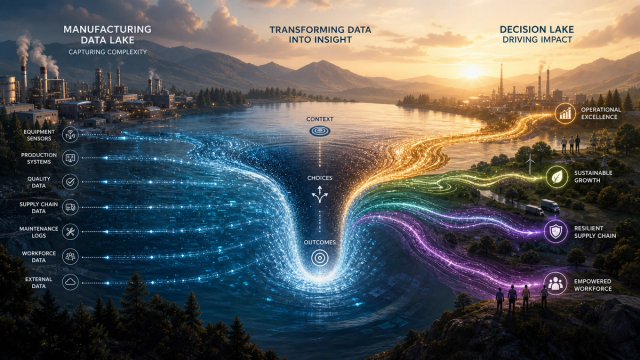
A digital twin is often introduced as a more accurate mirror of a physical asset, process, plant, or supply network. It may represent a rolling mill, a blast furnace, a warehouse, a mine haulage system, a production line, or an entire project. It may combine sensor readings, operational history, engineering models, schedules, quality information, and live events into a continuously updated view of the world.
That is valuable.
But a mirror, however detailed, does not tell people what to do next.
The greater promise of a digital twin is not that it can reproduce yesterday with impressive fidelity. It is that it can become a rehearsal space for tomorrow—a place where planners, engineers, operators, and leaders can test choices, compare consequences, and act with better awareness of uncertainty.
That is where the idea of a digital mind becomes useful.
A digital mind is not a machine pretending to be human. It is a decision capability built around the twin: one that understands the current state, simulates plausible futures, compares alternatives against real constraints, explains trade-offs, obtains appropriate authority, supports execution, and learns when reality differs from the simulation.
The distinction matters because many digital twin programmes stop at visibility. They create beautiful three-dimensional representations, live dashboards, and increasingly precise models of equipment. Users can see temperature, vibration, inventory, throughput, and quality conditions. Yet when a difficult decision arrives, the organization still relies on a planner’s spreadsheet, an operator’s experience, a hurried phone call, or a meeting assembled after the opportunity to act has narrowed.
Simulation without action is a very expensive picture.
FAQ targets
By the end of this chapter, you must have answers to these questions:
- What does digital twins need digital minds mean for manufacturing leaders?
- How can organisations apply this idea in manufacturing?
- What role do people and governance play?
- How can success be measured?
The situation people actually experience
Imagine a steel plant preparing to change its hot-rolling campaign. The production team wants to improve yield by grouping similar grades. The commercial team wants to protect a customer promise. Maintenance wants to use an emerging opportunity to inspect a critical section of the line. Energy management wants to reduce exposure to a high-tariff period. Logistics wants a sequence that avoids a dispatch bottleneck at the end of the shift.
Every team has a reasonable request.
The decision is not simply, “What is the current state of the mill?” The decision is, “What might the mill look like after each possible choice?”
If the campaign changes, will the expected yield improvement be consumed by an additional changeover? If maintenance is brought forward, which customer orders move? If the customer promise is protected, what inventory or energy consequence follows? If the plant pushes through the current sequence, what quality or equipment risk is being accepted?
A conventional twin may show the current line state accurately. A useful decision twin should allow the team to test these futures before committing the operation.
The operator does not need a perfect virtual replica. The operator needs to know which scenario is feasible, what it assumes, what it protects, and where it may fail. The plant manager does not need a more elaborate animation of the line. The plant manager needs a defensible choice under pressure.
This is the difference between modelling the operation and helping the operation decide.
The central argument
A twin simulates a system; a digital mind helps people choose what to do next under constraints and uncertainty.
The practical test is not whether the twin is visually impressive or technically complex. The test is whether it improves a recurring decision inside a real decision window.
That requires more than live data. It requires a named decision owner, visible constraints, relevant alternatives, explicit assumptions, a clear authority path, and a record of what happened afterwards.
The Twin-to-Decision Loop provides a practical structure:

1. Observe state: establish what is happening now and how fresh, complete, and trustworthy the evidence is.
2. Simulate futures: project plausible outcomes under different actions and assumptions.
3. Compare actions: evaluate choices against business, engineering, safety, quality, energy, customer, and workforce constraints.
4. Authorize: route the decision to the person or role with the appropriate authority.
5. Execute: carry out the chosen action within defined operational and technical boundaries.
6. Reconcile: compare the simulated future with what actually happened, then improve the twin and the decision process.
The loop is intentionally closed. A twin that simulates but never reconciles will gradually become a convincing fiction. A twin that observes but never supports action becomes another monitoring system. A digital mind is created when the model, the decision, the authority, the action, and the learning loop are designed together.
A twin is not automatically the truth
The word “twin” can create an expectation of perfect correspondence. In practice, every twin is a selective representation of reality.
It chooses which state variables to include, which events to trust, which relationships to model, which time horizon to represent, and which uncertainties to simplify. A furnace twin may capture thermal behaviour while missing a temporary operating practice. A warehouse twin may represent location and inventory while missing the fact that a particular aisle is difficult to access during a shift change. A project twin may represent tasks and dependencies while missing a supplier conversation that changed the likely delivery date.
The model is not defective because it is selective. The danger appears when its boundaries are hidden.
A decision-maker should be able to ask:
- Which parts of the current state are directly observed?
- Which parts are inferred?
- Which sources are stale or unavailable?
- Which physical or business constraints are represented?
- Which constraints are not represented?
- Which assumptions drive the scenario?
- How often has the model been compared with actual outcomes?
This is state fidelity. It is not only a matter of sensor accuracy. It is the degree to which the twin represents the aspects of reality that matter for the decision being made.
A twin built for maintenance may need a different state model from a twin built for customer promise recovery. The first may prioritize equipment condition, failure modes, and work orders. The second may need material identity, quality release, transport, customer priority, and contractual commitments. One physical plant can therefore have several useful twins, connected where necessary but not forced into a single universal representation.
State fidelity is decision-specific
A model can be accurate in one context and misleading in another.
Suppose a line twin predicts throughput with high confidence during stable production. The same model may be unreliable during a grade transition, after a maintenance intervention, or when an experienced operator applies a temporary workaround. The average performance figure hides the conditions under which the model should be trusted.
State fidelity should therefore be evaluated against a decision, not as a general badge attached to the twin.

For a hot-rolling defect decision, relevant state may include incoming slab chemistry, temperature profile, roll condition, recent alarms, speed changes, surface inspection, and the customer’s tolerance. For an energy decision, relevant state may include tariff periods, furnace condition, production sequence, demand charges, ambient conditions, and the cost of delaying a customer order. For a mine haulage decision, relevant state may include truck availability, road condition, fuel, loading queues, stockpile levels, and safety restrictions.
The right question is not “Is the twin accurate?”
It is “Accurate enough for which decision, under which conditions, and with what consequence if it is wrong?”
This framing also makes investment more rational. The organization may not need to instrument everything. It may need better visibility into a small number of state variables that determine whether a critical choice is safe and feasible.
Simulation should create choices, not theatre
The twin becomes useful when it can generate alternative futures.

A scenario is not simply a different line on a chart. It is a statement about an action, its assumptions, its expected consequences, and the conditions under which it should be revisited.
Consider three possible futures for a steel plant facing a likely customer delay.
Future one: protect the promise. Reallocate material, increase finishing priority, and secure transport. The customer promise is protected, but another order may move, overtime may rise, and a lower-priority customer may require early communication.
Future two: protect flow. Keep the current campaign and avoid an additional changeover. Overall throughput and yield may improve, but the strategic customer receives a revised date.
Future three: protect maintenance opportunity. Bring forward an inspection while the line is already available. Reliability risk may reduce, but immediate output and dispatch performance may suffer.
None of these futures is automatically correct. The correct choice depends on what the plant is trying to protect and which consequences it is prepared to accept.
A scenario service should therefore expose trade-offs rather than produce a single “optimal” answer without explanation. It should show the expected result, uncertainty range, constraints, affected orders or assets, and the point at which the decision should be reviewed.
The best scenario interface often resembles a well-prepared conversation. It helps the planner say, “If we choose this, we protect the strategic order but consume tomorrow’s finishing flexibility.” It helps the maintenance lead say, “If we defer this intervention, the probability of an unplanned stop increases under these operating conditions.” It helps leadership say, “Given our current priority, this is the trade-off we are willing to make.”
Agents give the twin a voice, and a responsibility
The addition of an AI agent can make a twin more operationally useful. An agent may gather evidence from multiple systems, identify a change in state, run scenarios, summarize trade-offs, prepare a decision brief, request approval, or execute a low-risk action through an approved tool.
But an agent should not be treated as a magical layer that turns an incomplete model into intelligence.
An agent needs a bounded role. It should know which decisions it supports, which tools it may call, which constraints it must never cross, which uncertainties require escalation, and who owns the final consequence.
For example, an agent supporting a rolling-mill campaign may be allowed to:
- collect current material, quality, schedule, and maintenance state;
- simulate three campaign alternatives;
- identify the likely customer and energy consequences;
- prepare a decision brief for the planning manager;
- reserve a provisional scenario in the planning system.
It may not be allowed to release material, override a quality hold, change a safety boundary, or alter a contractual priority without explicit authority.
The agent’s value lies in reducing the time and effort required to understand a decision. Its presence must not obscure who is authorized to choose or who is accountable for the result.
The operator’s experience matters
Digital twin programmes are often designed from the perspective of engineering, data science, or innovation. The operator encounters the result differently.
The operator may be standing in a noisy control room, managing several alarms, coordinating with maintenance, and dealing with a process that is behaving differently from the textbook case. A simulation that takes ten minutes to load is not useful during a two-minute intervention window. A recommendation that ignores a known refractory condition is not useful because it is mathematically elegant. A confidence score with no explanation does not help a person decide whether to trust the output.
Trust is built through small experiences:
- the twin reflects a recent state change quickly;
- the system distinguishes observation from inference;
- the recommendation acknowledges what it does not know;
- the scenario includes the constraints operators care about;
- the operator can challenge an assumption without fighting the interface;
- the chosen action is visible to the next shift;
- the actual outcome is used to improve the model.
People do not need the twin to agree with them every time. They need it to be useful when it disagrees.
An operator may know that the model has not seen a particular combination of material, temperature, and equipment condition. That knowledge should not be dismissed as resistance. It is evidence that the twin’s state representation is incomplete.
Calibration is not a technical afterthought
A twin must be calibrated against reality continuously enough to remain useful.
Calibration means comparing predicted state or outcome with observed state or outcome, identifying systematic differences, and deciding whether the model, the data, the process, or the operating assumption should change.
Suppose the twin predicts that a campaign change will take twenty minutes, but the plant repeatedly needs thirty-five minutes. The cause may be a missing setup step, a conservative safety practice, a resource conflict, a measurement problem, or a model parameter. The answer is not automatically to alter the model until the number looks better.
Similarly, if the twin predicts a quality improvement that does not appear, the organization should ask whether the input state was accurate, whether the relevant mechanism was modelled, whether the operation followed the assumed path, and whether the quality outcome was measured at the correct time.
Calibration should be visible to users. A scenario should carry a freshness and confidence indication appropriate to its decision. A model that performed well in stable conditions should not silently present the same confidence during an unfamiliar state.
Drift monitoring should cover more than data distributions. It should monitor changes in equipment, material, products, operating practices, customer mix, policies, and the decision environment.
The twin can remain technically healthy while becoming operationally irrelevant if the plant changes around it.
Safe experimentation in the physical world
The twin offers a powerful way to experiment without immediately experimenting on the plant.
This is especially valuable when the physical decision is costly, hazardous, difficult to reverse, or politically sensitive.
Before changing a furnace practice, the team can test the expected effect under a range of conditions. Before diverting mine haulage, it can explore queue and fuel consequences. Before changing warehouse slotting, it can examine travel time and congestion. Before moving a project milestone, it can identify downstream dependencies and contractual exposure.
But simulation is not a guarantee of safety. It is a structured way to reduce uncertainty.
Safe experimentation requires clear boundaries:
- define which decisions may be tested only in simulation;
- distinguish scenario exploration from an approved operating plan;
- identify hard safety, quality, and regulatory constraints;
- require human authorization before real-world execution;
- define rollback or containment where possible;
- record the assumptions and actual conditions;
- stop when the operating state leaves the model’s valid range.
The twin should also support tabletop rehearsal. A shift team can ask what it would do if a key sensor failed, a crane became unavailable, a quality hold extended, or a customer changed priority. The value is not only the simulated answer. It is the shared readiness created by rehearsing the decision before the crisis.
A digital mind must understand uncertainty
Industrial decisions rarely have one certain future. They have a set of plausible futures, each with different probabilities, costs, and consequences.
A useful digital mind should therefore distinguish three things:
1. What is known: directly observed facts with reliable timestamps.
2. What is inferred: estimates produced from patterns, models, or incomplete evidence.
3. What is assumed: conditions introduced to make the scenario possible.
This distinction is more useful than presenting a single precision number. A planner may accept a scenario with moderate confidence if the action is reversible and the downside is limited. The same planner may require much stronger evidence before changing a quality disposition or stopping a critical line.
The system should also show sensitivity. If a recommendation changes dramatically when one uncertain input changes slightly, the decision-maker should know. That may be a reason to gather more information, select a more robust option, or delay execution until the uncertainty narrows.
Robustness is often more valuable than theoretical optimality. A slightly less efficient plan that performs acceptably across several plausible futures may be safer than an optimal plan that depends on one fragile assumption.
Industry examples
Hot-rolling defect risk
A twin combines slab chemistry, temperature, roll condition, speed, cooling, and inspection data to simulate defect risk under alternative settings. A digital mind does more: it explains which variables are driving risk, identifies the customer and inventory consequences, proposes a bounded adjustment, and routes the decision to the responsible process owner.
If the model lacks current roll-condition data, it should say so. The human should not receive a polished recommendation that quietly assumes the equipment is in a normal state.
Furnace energy exposure
A furnace twin can estimate energy consumption under different production sequences. The decision capability can compare energy savings with campaign disruption, yield, customer date, emissions exposure, and labour requirements. It can identify the last practical time to change the sequence and show what happens if the plant waits.
The purpose is not to minimize energy in isolation. It is to make the enterprise trade-off visible.
Mine haulage
A mine twin can represent truck location, road condition, loading queues, stockpiles, fuel, and crusher capacity. A digital mind can test a diversion, show its effect on queue length and delivery, identify safety restrictions, and request approval when the choice crosses a defined operational boundary.
Warehouse throughput
A warehouse twin can simulate slotting, picking paths, labour allocation, dock capacity, and order waves. A decision agent can prepare an alternative wave plan when congestion increases, but should not assume that a mathematically shorter route is operationally better if it creates unsafe crossing patterns or overloads a particular team.
Project schedule
A project twin can model dependencies, resources, procurement, design maturity, and milestone dates. A digital mind can compare recovery strategies: overtime, resequencing, scope change, supplier escalation, or milestone negotiation. It can show the cost and risk of each option while preserving the project manager’s authority over the final choice.
Across these examples, the twin is not valuable because it resembles the physical system. It is valuable because it helps people rehearse a decision before the decision becomes expensive.
Architecture without abstraction
The architecture should follow the Twin-to-Decision Loop.

The first layer is a real-time state model that combines sensor data, operational transactions, maintenance, quality, logistics, schedules, documents, and human observations. Each piece of state should carry source, timestamp, confidence, and ownership where practical.
The second layer is a physics and machine-learning model. Physics-based models provide structure and interpretability. Machine-learning models can capture patterns that are difficult to express explicitly. A hybrid approach is often more useful than treating physics and data as competing religions.
The third layer is a scenario service that allows the system to change actions and assumptions without changing the physical plant. It should generate alternatives over a relevant time horizon and identify the constraints that make each option feasible or infeasible.
The fourth layer is optimization and decision logic. It should express objectives and hard boundaries clearly. Quality, safety, contractual, and regulatory constraints should not be hidden inside a score that can be traded away silently.
The fifth layer is an agent that gathers evidence, explains scenarios, prepares recommendations, and performs only the actions allowed by its authority contract.
The sixth layer is workflow and human authority. It routes the recommendation to the correct person, captures approval or challenge, manages escalation, and supports shift handover.
The seventh layer is calibration and drift monitoring. It compares predicted and actual outcomes, detects changing conditions, and triggers review when the twin is outside its validated range.
The final layer is reconciliation. It closes the loop by recording what was selected, what occurred, and what the organization learned.
For higher-autonomy use cases, add explicit identity, permissions, tool boundaries, audit, simulation, escalation, and rollback. The digital mind should never become an unaccountable control plane simply because it can access more systems.
A practical ninety-day starting sequence
Days 1–30: Choose one decision, not one asset
Begin with a recurring decision whose consequences are meaningful but bounded. Examples include campaign change, maintenance timing, quality containment, energy scheduling, haulage diversion, or warehouse wave planning.
Interview the people who make the decision. Ask what they observe, what they simulate mentally, which constraints are invisible in systems, what information arrives too late, and what happens when the recommended action is wrong.
Map the current decision without proposing technology. Identify the state required, the alternatives, the authority, the execution path, and the outcome measure.
Days 31–60: Build the smallest useful twin
Do not begin with a complete virtual replica of the enterprise. Build the smallest state model that can support the chosen decision. Make the boundary explicit. State what the twin represents and what it does not.
Create a few credible scenarios rather than a catalogue of every possible future. Test whether the scenarios reflect the constraints known by operators, planners, quality, maintenance, logistics, and customer-facing teams.
Days 61–90: Rehearse before recommending
Run the twin in shadow mode. Let the team compare its simulated futures with human judgement and actual outcomes. Ask whether the scenarios are understandable, whether the assumptions are visible, and whether the proposed choices are executable.
Record disagreement as learning evidence. If reality differs from the twin, investigate the state, assumptions, model, process, or policy. Do not quietly adjust the output until it agrees with the most recent decision.
After the shadow period, select a narrow, reversible action for controlled use. Define stop conditions, authority, monitoring, and reconciliation before enabling execution.
Questions for leaders
- What recurring decision will this twin improve?
- Which state variables matter for that decision?
- Which parts of the state are observed, inferred, or assumed?
- What alternatives should the twin compare?
- Which constraints are hard and must never be optimized away?
- How will users know when the twin is outside its validated range?
- Who has authority to approve, reject, pause, or execute the recommendation?
- What is the safe failure mode when data or connectivity is incomplete?
- How will the organization distinguish model error from a changed operating practice?
- What will be recorded when the human disagrees with the twin?
- How often will predicted outcomes be reconciled with actual outcomes?
- What evidence would justify giving the agent more authority later?
Conclusion: the twin must help people rehearse reality
A twin earns its place when it helps people rehearse difficult choices, not merely admire a detailed model of yesterday.
Its value is not proportional to visual sophistication. A detailed three-dimensional model that cannot compare actions may be less useful than a modest decision twin that shows three credible futures and makes their trade-offs understandable.
The digital mind is the layer that turns representation into judgement support. It observes the state, simulates the future, compares actions, respects authority, supports execution, and reconciles the result with reality. It does not remove uncertainty. It gives people a better way to work with it.
That is especially important in manufacturing because the operation is never entirely captured by a database. Physical behaviour, material variation, equipment condition, human experience, customer commitments, local workarounds, and external events all shape the next decision. The twin should bring these realities into a disciplined conversation rather than pretending they do not exist.
The work begins with one recurring decision, one group of people, and one honest learning loop. Build a twin for the choice that matters, not simply for the asset that is easiest to model. Let people test the future before they commit the present. Let disagreement improve the representation. Let every scenario carry its assumptions, authority, and consequences.
Simulation without action is a picture. Simulation connected to human judgement, bounded execution, and learning becomes decision intelligence.
Disclaimer
Industry situations in this chapter are composite illustrations unless explicitly attributed to a public source. They are not claims about any particular company, plant, vendor, customer, or incident. The ideas are intended for editorial and strategic discussion. Digital twin models and AI recommendations must be validated against local engineering practice, safety, quality, cybersecurity, regulatory, contractual, labour, data-governance, and operational requirements. Illustrative scenarios should not be treated as certified process models or as substitutes for formal engineering analysis, professional judgement, or established plant procedures.
#DigitalTwin #ManufacturingSimulation #DecisionIntelligence #ManufacturingAI #ScenarioPlanning #IndustrialAI #SmartManufacturing #OperationalExcellence #DigitalTransformation #IndustrialDigitalTwin