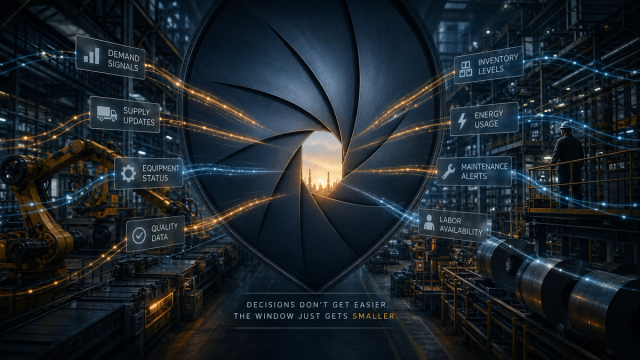
An AI-native project office should not be a machine that produces more status reports. It should help teams notice weak signals, test assumptions, and prepare decisions before a programme becomes difficult to recover.
That is a different ambition from automating the weekly report.
Most project teams do not suffer from a complete absence of information. They suffer from information that arrives in pieces, at different levels of confidence, and at different speeds. A supplier gives a cautious update. An engineer leaves a design question unresolved. A commissioning window quietly becomes narrower. A commercial assumption remains valid only if three other conditions hold.
The project office often discovers the full story only after the green status has become red.
An AI-native PMO should help the team see the story while it can still change the outcome.
FAQ targets
By the end of this chapter, you must have answers to these questions:
- What does the ai-native project office mean for manufacturing leaders?
- How can organisations apply this idea in manufacturing?
- What role do people and governance play?
- How can success be measured?
The situation people actually experience
Imagine a major manufacturing expansion project. A new finishing line is being installed while the existing plant continues to serve customers. The programme has a fixed commissioning window, specialist equipment is arriving from several suppliers, and the plant must coordinate civil works, electrical installation, controls, quality validation, operator training, and production trials.
The formal project report is still green.
The civil contractor has completed its work. The main equipment shipment is on site. The electrical workstream has met its weekly target. Procurement has not yet recorded a purchase-order exception. Each workstream can legitimately report progress.
But a project manager notices a pattern. The supplier’s latest documents contain more open questions than usual. A design clarification has been waiting for approval. The controls engineer is spending time resolving interface assumptions that were thought to be closed. The operator training plan has been moved twice because the line sequence is not stable.
No single item has crossed the threshold for a red status. Together, they suggest that the commissioning window is becoming fragile.
The project manager now faces several choices:
- escalate the design clarification immediately;
- bring the supplier to site earlier;
- change the commissioning sequence;
- protect a smaller pilot scope;
- move training to a different stage;
- or accept the risk and continue with the current plan.

The PMO does not need another chart. It needs a way to assemble the weak signals, show the dependency chain, and prepare the conversation before the programme loses its recovery options.
The central argument
An AI-native project office should function as a project intelligence layer: a colleague that notices patterns, preserves decision context, and helps programme teams act before a risk becomes an incident.
It should help the team understand:
1. what has changed;
2. which assumptions are weakening;
3. which dependencies may be affected;
4. what decisions are becoming urgent;
5. which options remain feasible;
6. who owns the next choice; and
7. what consequence follows from waiting.
The PMO should not replace the project manager’s judgement or turn every uncertain pattern into an escalation. Its role is to improve the quality and timing of attention.
The practical test is not whether the AI can produce a polished report. It is whether the programme team can have a better conversation earlier because the system has connected evidence that would otherwise remain scattered.
Why status reporting misses weak signals
Traditional project reporting depends on thresholds. A workstream reports green, amber, or red based on its own plan, tolerance, and immediate evidence.
This is useful for governance, but it can miss the relationships between small changes.
One delayed document may be manageable. One unresolved interface question may be manageable. One training movement may be manageable. But when all three relate to the same commissioning path, the combined risk is greater than the individual statuses suggest.
This is the difference between reporting events and understanding dependencies.
A project intelligence layer should look across:
- commitments and milestones;
- design decisions and open clarifications;
- supplier communications;
- change requests;
- assumptions and their expiry dates;
- risk and issue registers;
- procurement and delivery signals;
- resource availability;
- commissioning readiness;
- quality and regulatory gates;
- and decisions waiting for authority.
The aim is not to create a perfect prediction of project failure. It is to make the emerging conversation visible.
The human work of a project office
Project offices are sometimes criticised for administration, but much of their real value is connective work.
They remember why a decision was made. They notice when two workstreams are using different assumptions. They ask whether a change has reached all affected teams. They turn a supplier concern into an action. They prepare the programme manager for a difficult steering discussion.
An AI-native PMO should support this work rather than remove it from view.
- For a project manager, it can reduce the time spent assembling updates and increase the time available for resolving issues.
- For a workstream lead, it can show which commitments depend on an unresolved decision.
- For a sponsor, it can distinguish a genuine strategic choice from a request for routine information.
- For a supplier manager, it can reveal when repeated wording changes indicate a deeper delivery concern.
- For the programme team, it can preserve the reasoning behind decisions so the project does not repeatedly reopen settled questions.
A practical example: the commissioning window
Suppose an integrated steel plant is preparing to commission a new line during a planned maintenance shutdown. The shutdown date is fixed because several downstream operations depend on it.
The project plan shows that equipment installation is on track. But the AI-native PMO detects the following pattern:
- the final control logic package has changed twice;
- the test procedure references an earlier equipment configuration;
- two experienced operators are unavailable during the planned training week;
- the supplier has asked for an additional site visit;
- and the quality validation team has not yet confirmed the evidence required for release.
None of these signals proves that commissioning will fail. Together, they create a decision worth discussing now.
The PMO should prepare a decision brief:

Situation: commissioning readiness is uncertain across controls, training, supplier support, and quality evidence.
Decision deadline: confirm the commissioning scope before the shutdown begins.
Options: proceed with full scope, commission a limited scope, move the shutdown, or add specialist support.
Consequences: cost, customer exposure, learning opportunity, operational disruption, and future schedule flexibility.
Open evidence: final control package, operator availability, validation protocol, supplier response.
Decision owner: programme sponsor with operations, engineering, quality, and supplier input.
This is not a prediction of failure. It is a better starting point for a conversation.
What the AI-native PMO should do
Notice patterns across workstreams
The system should identify relationships that are difficult to see in separate reports. Repeated movement of a milestone, increasing clarification traffic, growing change requests, or a supplier’s shifting language may indicate a pattern.
The system must show why the pattern was surfaced. Otherwise, it creates a new form of unexplained project anxiety.
Test assumptions
Projects depend on assumptions: a supplier will deliver by a date, a permit will be approved, a resource will be available, a design will not change, a customer will accept a temporary arrangement.
The PMO should track assumptions as live conditions. It should ask whether the evidence still supports them and what decisions depend on them.
Connect dependencies
An unresolved decision in engineering may affect procurement, installation, testing, training, quality release, and customer communication. The system should show the path rather than leave each team to discover it separately.
Prepare decision briefs
The PMO should turn scattered evidence into a concise, human-readable brief: what changed, why it matters, what choices remain, who must decide, and by when.
Preserve decision memory
Record not only the final decision, but the assumptions, options, evidence, dissent, authority, and outcome. This prevents the programme from returning to the same debate without learning from the earlier one.
When project intelligence becomes harmful
Alert inflation
If every weak signal becomes an escalation, teams learn to ignore the system. The PMO must distinguish a pattern worth discussing from normal project variation.
False precision
A system may assign a project risk a numerical probability that appears objective but depends on incomplete or inconsistent reporting. Confidence should be explained, not merely displayed.
Surveillance culture
If AI is used to rank individuals rather than improve project decisions, people will optimise their reporting behaviour. They may hide uncertainty to protect their status, making the project less visible rather than safer.
Dependency blindness
The system may connect formal task relationships while missing informal dependencies: one expert’s knowledge, a supplier’s trust relationship, a plant access constraint, or a customer’s tolerance for disruption.
Recommendation without authority
The PMO may identify the right decision but lack the power to settle it. A useful brief must name the accountable decision owner and the escalation path.
Report substitution
The organisation may celebrate automated summaries while the underlying project conversations remain weak. A shorter report is not the same as a healthier programme.
From prediction to project action
Prediction can identify a likely slippage, cost exposure, resource conflict, supplier concern, or commissioning risk. The programme value appears when the insight changes a choice.
Ask:
1. Which project decision does this signal affect?
2. What assumption is weakening?
3. Which dependency is likely to move next?
4. What choices are still open?
5. Which option preserves the most schedule or scope flexibility?
6. Who has the authority to decide?
7. What must be true for the recommendation to work?
The system should be able to say, “This pattern deserves a conversation,” without pretending that it knows the final outcome.
Architecture for an AI-native project office

Project record layer
Connect schedules, milestones, costs, contracts, procurement, risks, changes, decisions, documents, and resource plans.
Dependency and semantics layer
Make relationships and definitions explicit. Clarify what “complete,” “ready for commissioning,” “approved,” “accepted,” and “on track” mean in the programme context.
Assumption and evidence layer
Track assumptions, evidence freshness, confidence, owner, expiry date, and affected decisions.
Intelligence layer
Use rules, pattern detection, retrieval, summarisation, scenario analysis, and agent assistance to surface emerging concerns and prepare briefs.
Governance and authority layer
Route decisions to sponsors, programme managers, workstream leads, quality, operations, or commercial owners. Record approvals, dissent, escalations, and changes.
Outcome layer
Compare what the project expected with what happened. Capture the cause of variation and the decision that influenced it.
A practical 90-day sequence
Days 1–30: Find the conversations that arrive too late
Choose one active manufacturing project and reconstruct three situations: one that was recovered early, one that became a late escalation, and one that succeeded through personal heroics.
Interview the project manager, workstream leads, supplier manager, operations representative, quality representative, and sponsor. Ask what they knew, when they knew it, which assumption changed, and what decision they wished had happened earlier.
Days 31–60: Build the project decision brief
Create a simple brief with the pattern, affected dependencies, weakening assumptions, options, decision owner, deadline, and evidence still required.
Use historical project cases to test whether the brief would have surfaced the issue early enough and whether its recommendations are genuinely feasible.
Days 61–90: Run in shadow mode
Let the AI-native PMO prepare emerging-risk briefs without changing the formal project governance process. Compare its observations with the team’s actual decisions and outcomes.
Measure early-warning time, repeated status preparation, unresolved-decision age, assumption failures, escalation quality, and recovery success.
After 90 days: Make intelligence part of the project rhythm
Assign ownership for the decision briefs, assumptions, outcome learning, and system behaviour. Review false positives and missed signals openly. The goal is not to create a perfect warning machine; it is to improve the quality of project attention.
Questions for leaders
- Which project decisions are currently discovered too late?
- What assumptions carry the greatest consequence?
- Which weak signals are visible separately but not together?
- Where do teams repeatedly prepare the same status information?
- Which decisions have a clear owner but poor evidence?
- Is the PMO improving conversations or only producing more reports?
- How will we distinguish useful early warning from alert inflation?
- What should the system do when the evidence is incomplete?
- What outcome will prove that project intelligence is valuable?
Conclusion: make the right conversation happen earlier
The useful PMO is not the one that knows the most project data. It is the one that helps the team have the right conversation early enough to matter.
Projects rarely fail because nobody cared. They fail because assumptions weakened quietly, dependencies were understood separately, difficult decisions were postponed, and the cost of recovery grew while the project still looked manageable.
An AI-native project office can help by making weak signals visible without turning every signal into drama. It can assemble the evidence, connect the dependencies, prepare the options, and preserve the reasoning behind the choice.
The project team must still decide. The sponsor must still accept trade-offs. The workstream lead must still own delivery. The purpose of AI is to improve the quality and timing of those human responsibilities.
Begin with one programme and one conversation that regularly arrives too late. Find the assumptions behind it. Make the dependencies visible. Prepare the decision before the escalation. Then learn from what happened.
That is the beginning of an AI-native project office: not more status, but earlier understanding and better action.
Disclaimer
Industry situations in this chapter are composite illustrations unless explicitly attributed to a public source. They are not claims about any particular company, plant, vendor, or incident. Implementations must be validated against local safety, quality, cybersecurity, regulatory, contractual, labour, and data-governance requirements.
#AINativePMO #ProjectManagement #ProjectIntelligence #ManufacturingProjects #AIinManufacturing #ProgrammeManagement #DecisionIntelligence #OperationalExcellence #DigitalTransformation #ProjectLeadership