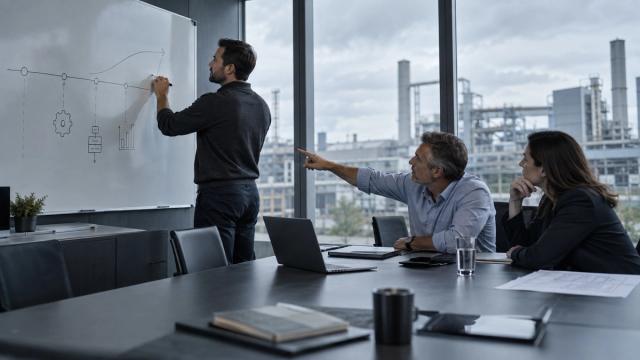
Every plant that gets visited for this kind of work has a stack of reports that say, with complete confidence, that everything is running as planned. And it has a shop floor that quietly, wordlessly disagrees with those reports in a dozen small ways nobody has ever bothered to log. It's worth being precise about what this actually is, because it would be easy to mistake it for a story about dishonesty, and it almost never is. It's the natural, structural gap between what a reporting system was built to capture and what actually happens on a production line, shift after shift, hour after hour, when nobody holding a dashboard happens to be watching. A week of direct observation closes that gap faster and more completely than any amount of additional report review ever could, and it reliably surfaces things a report is, by its very design, structurally incapable of showing you.

What reports are built to show, and what they're built to hide
A production report is built to answer the specific questions someone thought to ask when it was first designed, sometimes years earlier, often by someone no longer even at the company. If a machine hits its planned throughput for the shift, the report says so, cleanly and correctly, even if it hit that throughput because an operator has been quietly, skillfully compensating for a slowly drifting sensor for the past three weeks. An adjustment nobody thought was worth mentioning to anyone, because the visible outcome still looked entirely fine. The report isn't lying in any meaningful sense. It's simply, structurally blind to anything nobody anticipated when its fields and thresholds were originally defined.
This is the fundamental limit of reporting as a diagnostic tool, and it's worth sitting with rather than rushing past. A report can only ever tell you about the categories it was explicitly built to measure. Workarounds, informal compensations, small judgment calls made quietly and repeatedly shift after shift, all of these live in the gap between the defined categories, entirely invisible to any dashboard, however sophisticated its visualizations or however real-time its data feed happens to be. You can spend a fortune on analytics and still be structurally unable to see the thing that's actually happening two feet from the sensor.
What shop-floor observation actually looks like in practice
Observation, done properly, doesn't mean auditing, and it doesn't mean inspecting against a checklist. Both of those activities announce themselves, and people behave differently the moment they know they're being checked against a standard. It means spending genuinely unstructured time on the floor, watching a process run in real time without an agenda, and asking operators open, curious questions about what they're actually doing and why, rather than what the procedure manual says they should be doing.
A useful discipline, built up over years of doing this: watch first, for a good long while, before asking anything at all. Ask questions second. And resist, actively resist, the very strong urge to explain what "should" be happening, because the moment you do that, you've stopped learning and started correcting, and the conversation changes character immediately. The goal of a week like this isn't to check compliance against a written procedure. It's to see, with fresh eyes, what people are actually doing to make the process work in practice, especially the parts that never made it into any procedure document because nobody ever thought to write them down, or because the official procedure was written for conditions that quietly stopped applying years ago.
A full week is usually enough time to see a complete production cycle unfold, across different shifts and different individual operators, and to notice the informal variation between them that's often invisible from a single day's snapshot but becomes almost impossible to miss once you've watched the same station handle the same task five or six separate times with five or six different people.
Three things you can only learn by watching, not reading
There are, typically, three specific categories of insight that observation reliably surfaces and that reports reliably, structurally miss.

First, compensating behavior. An operator quietly adjusting a setting, a feed rate, a timing parameter, to keep an output looking normal on paper, without ever formally reporting the underlying issue that made the adjustment necessary in the first place, because reporting it honestly feels like more trouble, more paperwork, more scrutiny than it's worth, especially if the adjustment has worked reliably so far.
Second, informal workarounds. A step that exists nowhere in the official procedure, but that every single person on the floor treats as simply necessary, often because the official procedure was written years earlier for conditions, a different raw material supplier, an older piece of equipment, a different product mix, that no longer hold true today.
Third, silent knowledge. The constant, almost unconscious judgment calls that experienced operators make dozens of times a shift, based on cues, a particular sound, a specific smell, a slight vibration felt through a control panel, that were never captured as a measurable parameter anywhere in any system, and quite possibly never will be, because nobody has yet figured out how to turn "it sounded a little off today" into a sensor reading.
Operators have sat down and described, with real confidence, a machine that "wasn't quite right" a full shift before any alarm fired or any report flagged an anomaly. That knowledge exists nowhere except in their heads and their hands, and no report review, however thorough, will ever surface it. Only being there does.
Making observation part of your standard diagnostic toolkit
None of this argues against reporting. Reports remain genuinely essential for scale, for trend visibility across time, for comparing performance across multiple sites where you simply cannot be physically present everywhere at once. But observation should be a standing, deliberate part of any serious operational diagnostic, built in from the start, rather than a last resort reached for only once the numbers have already stopped making sense to anyone reviewing them from a distance.
Building in a full week of direct floor time at the very beginning of any assessment, before the formal data review even begins, changes the character of what questions eventually get asked of that data, because by the time you sit down with the spreadsheets, you already know, from having watched it happen, what to actually look for. The data review becomes sharper, faster, and considerably more targeted, because you're no longer fishing blindly through categories hoping something interesting surfaces.
The line that looked perfect on paper
During one advisory engagement, the production reports for a particular line showed it consistently hitting its planned throughput target, week after week, with a consistency that on paper looked like a genuine operational success story. A week spent physically on the floor told an entirely different story. An operator was manually adjusting a feed rate several separate times per shift, in small, practiced increments, to compensate for a sensor that had, as it turned out, been slowly drifting out of calibration for several weeks. That adjustment was skillful enough, and consistent enough, that it kept the reported output looking exactly as expected every single time, with no visible anomaly for any report to catch.
Nobody had logged the underlying drift, because from the report's narrow point of view, nothing was wrong at all. The numbers said everything was fine, because the operator's quiet compensation was doing exactly the job the sensor itself should have been doing. The underlying sensor issue, completely invisible in every system report reviewed back at headquarters, surfaced within two days of direct observation on the floor. It would very likely have stayed invisible indefinitely otherwise, since the reporting system had, quite literally, no field designed to capture "operator quietly compensating for equipment drift that nobody has officially acknowledged yet."
What struck me most about that particular case wasn't the finding itself. Drift and compensation are common enough patterns. What struck me was how close the organization had come to treating that line as a genuine best-practice example to be replicated elsewhere, purely because the reported numbers looked so consistently good.
Running your own observation week without disrupting the floor
If you want to try a version of this yourself, a few practical habits make a real difference. Tell the team you'll be there, and be honest about why. People can tell the difference between someone quietly learning and someone quietly auditing, and the moment they suspect the latter, the behavior you actually want to see disappears behind a more careful, performed version of itself. Rotate across shifts deliberately, including the ones leadership rarely visits. The night shift and the weekend shift often behave meaningfully differently from the Tuesday-afternoon shift that happens to get all the visits, simply because it's more convenient for visitors.
Resist the pull to bring a clipboard and a checklist, at least at first. A clipboard signals inspection, and inspection changes behavior. Carry a notebook instead, and write down questions rather than scores. And build in real time to just stand still, not walking, not interviewing, just present and watching a single station for twenty or thirty minutes at a stretch. Most people rush this part, moving from station to station too quickly to notice the small, repeated adjustments that only become visible once you've been standing in one spot long enough that people forget you're there.
Finally, resist reporting findings the same day. The temptation to walk straight from the floor into a leadership meeting with "you won't believe what I just saw" is strong, but a single day's observation can mislead as easily as a single day's data point can. Let the full week play out, across shifts and operators, before drawing conclusions. The value of observation comes from the pattern across many hours, not the drama of any single moment.
Spend a shift where the metric is generated
Before trusting any metric that everyone around the table treats as settled and reliable, spend an actual shift standing where that specific metric is physically generated. Watch the process, not the dashboard. The report will faithfully tell you what the system was originally built to notice, however many years ago that design decision was made. Only direct observation reliably tells you what it wasn't built to notice, and that gap, typically, is exactly where the most consequential, and most fixable, operational surprises tend to live.
If you're looking for a place to start, pick the single metric in your operation that everyone currently treats as the most reliably "good," the one nobody questions anymore precisely because it always looks fine. That's very often the most valuable place to spend a shift, not the metric that's already causing visible concern, because a metric that looks too consistently good for too long is, more often than not, at least worth a second look before you hold it up as the standard everyone else should meet.

It's also worth gently pushing back on the idea that this kind of observation is a luxury reserved for consultants or corporate visitors with time to spare. Plant managers and operations leaders can and should build a version of this into their own regular rhythm, not a formal week-long study every time, but a standing habit of spending real, unstructured time on the floor, without an agenda, on a recurring basis. The organizations that do this well treat it the way a good doctor treats a physical exam: not a substitute for the lab results, but a source of information the lab results were never designed to capture in the first place. The two together, observation and reporting, tell you far more than either one alone ever could.
Disclaimer
Industry situations in this chapter are composite illustrations unless explicitly attributed to a public source. They are not claims about any particular company, plant, vendor, or incident. External standards, research, and public case studies should be verified before publication. Implementations must be validated against local safety, quality, cybersecurity, regulatory, contractual, labour, privacy, and data-governance requirements. AI recommendations and autonomous actions should remain within clearly defined human authority, operational controls, and tested recovery procedures.
#ShopFloorManagement #ManufacturingLeadership #GembaWalk #SteelIndustry #OperationsExcellence #ContinuousImprovement #PlantManagement #LeanManufacturing #Industry40 #ProcessDiagnostics
Further reading
- Tacit Knowledge Is Your Next Competitive Moat
California Management Review, March 16, 2026
- How to Conduct an Effective Gemba Walk in Manufacturing
Fabrico, February 24, 2026
- Almost 8 in 10 manufacturing operators bypass official systems to get work done, new research reveals
Plant & Works Engineering, August 21, 2026
- How Gemba Walks Sustain a Strong Continuous Improvement Culture in Factories
Tervene, updated September 11, 2025
- Operators Adapt, Systems Rarely Do
ATC Group, updated August 26, 2026